On 2003 Mustang Gt Do I Need to Beef Up Front Suspension for Turbo
What is Slant?
Camber is the tire lean when viewed from the front of the car. The elevation of the tire tin either lean in, lean out, or be perfectly vertical. At first, you might think a perfectly vertical orientation is preferred, just that's but the instance on flat tracks.
A little negative camber tin can raise your Mustang'south cornering ability, allowing the outside tire to grip amend in the corner since the lower side of the tire will tend to try and ringlet nether equally information technology turns.
Positive camber is when the upper finish of the tire leans out further than the bottom. Positive slant should be avoided, equally it is detrimental to handling in nearly all cases.
Aught camber is when the wheel and tire are perfectly straight, vertically.
Every bit you lower your Mustang, you lot also create negative camber on the front wheels. If left out of spec, expect reduced tire life. In some cases, a trip to the alignment shop volition preserve your tires. The more lowering involved, still, the greater the take chances you'll need to enlist the assist of camber plates for your front end shock towers.
What is Pulley?
Caster is the human relationship betwixt the steering axis and a truthful vertical position. For the Mustang, the steering axis is the strut. A higher caster bending gives a machine more than stability at college speeds. Although at slower speeds, the steering will feel heavier. Pulley tin can also enhance the camber angle as the bike is turned, giving you more grip in a plow.
What is Toe-In and Toe-Out?
Toe bending is how the tires indicate when looking at them from a bird's eye perspective. Toe-in has the two tires pointing slightly towards the middle of the car, while toe-out has them pointing away from center. A slight amount of toe-in helps college speed stability since the wheels will toe-out slightly equally speeds increase.
Older Mustangs (Foxbody up to well-nigh New Edge) tend to suffer from toe-in while turning. Aftermarket K-members tend to help prevent this, but it's quite the fourth dimension sink. Only consider a Thousand-member if you're willing to change out ninety% of your Mustang's suspension.
What is an Alignment?
An alignment refers to a process that alters the slant, caster, and toe angle to make sure the vehicle is set correctly. What is considered "correct" refers to factory specs, but in the event you have a race-prepped Mustang, some more ambitious settings enhance break performance.
Slant and caster are ready at the forepart shock belfry or the strut itself. Toe is adapted via the steering necktie rods. While you can change the alignment at home, information technology's all-time to take it to a shop that can accurately measure your Mustang's front suspension adjustments.
Adjusting Alignment with Caster/Slant Plates
Although the acme of your front shock towers allows you lot to adjust the vehicle's camber, you'll likely find the adaptability is minimal. Peculiarly truthful with lowered cars, there may simply not be enough adjustability to bring everything dorsum into spec. Fifty-fifty some factory Mustangs prior to 2005 can have trouble returning to spec with the available adjustments.
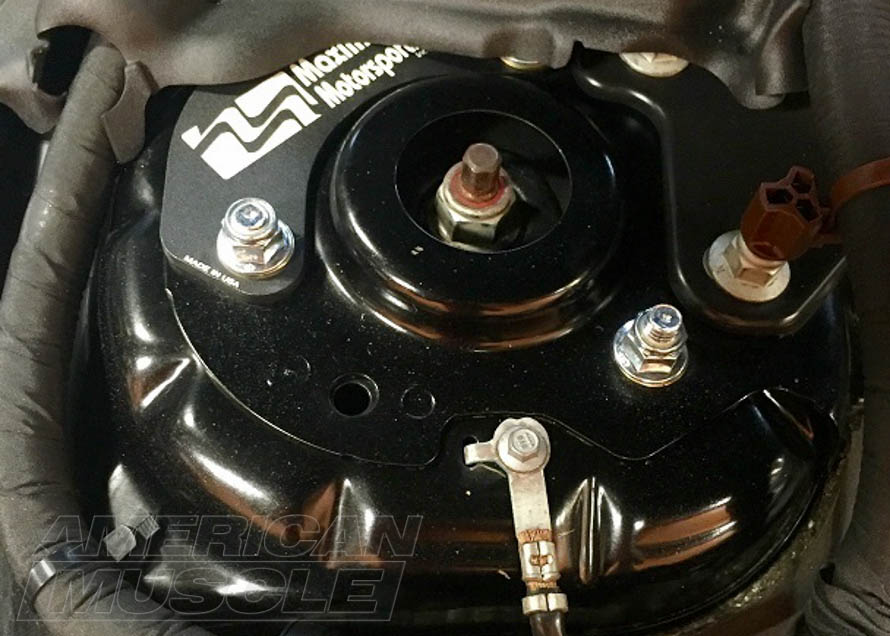
This is where caster/camber plates come up in. They give you a much greater range of adjustability for camber, while also able to tweak your caster angle. All in all, you're looking at a more than counterbalanced front end with the possibility of improving turning radius (depending on how much you tweak the caster). Whether you're looking to heighten your vehicle's cornering power, or bring it back into spec, a set of pulley/slant plates is a worthwhile investment. Pairing a gear up of caster/camber plates with an aftermarket K-member volition provide the most adjustment for caster.
Ane Pulley Camber Plate
The Mustang Uni-Body Chassis
The Mustang uses a chassis with two main components, the front and rear subframe. While the two sections are connected past the flooring pan, this is cypher more than than sail metal. The actual frame track are not connected. While the rest of the machine's body provides some rigidity, there can be unwanted flex when you lot stress the chassis. This stress can be a result of difficult cornering or dragstrip launches. The solution for this is simple, and can be plant in the class of subframe connectors which will tie the front and rear subframes together, thus stiffening the chassis.
- Bolt-on subframe connectors offer easier installation
- Welded connectors provide more stiffness than bolt-ons
- Strut tower braces reduce body flex in a different fashion than subframe connectors
- Some strut braces clear superchargers
- Rear daze braces are a small upgrade only still reduce flex. Ordinarily requires welding
- Torque box braces dampen the force of hard launches
- A total roll cage offers the most rigidity
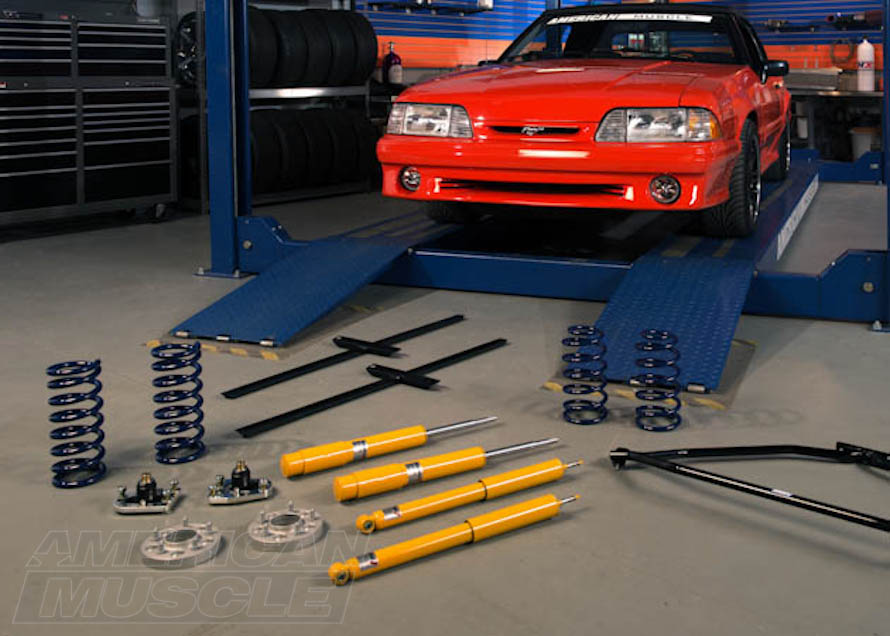
Mustang Suspension Parts
At that place are a variety of suspension components controlling how your Mustang handles:
- Ball joints
- Crash-land steer kits
- Control arms (Not applicative to S550 Mustangs)
- Sway bars
- Shocks and struts
- Springs
- Strut and shock tower braces
- Panhard bar (Not applicable to S550 Mustangs)
- Vertical links (S550 but)
- Toe rods (S550 only)
- IRS bushings (S550 only)
With all of the above coming standard on your Mustang, at that place are a good bit of aftermarket add-ons that either replace an existing component or are a completely new addition. These include:
- Air lift break kits (replaces shocks, struts, and springs)
- Coil over kits (replaces shocks, struts, and springs)
- Watts Link kits (replaces panhard confined)
- Caster camber kits
Common Mustang Front Suspension Components
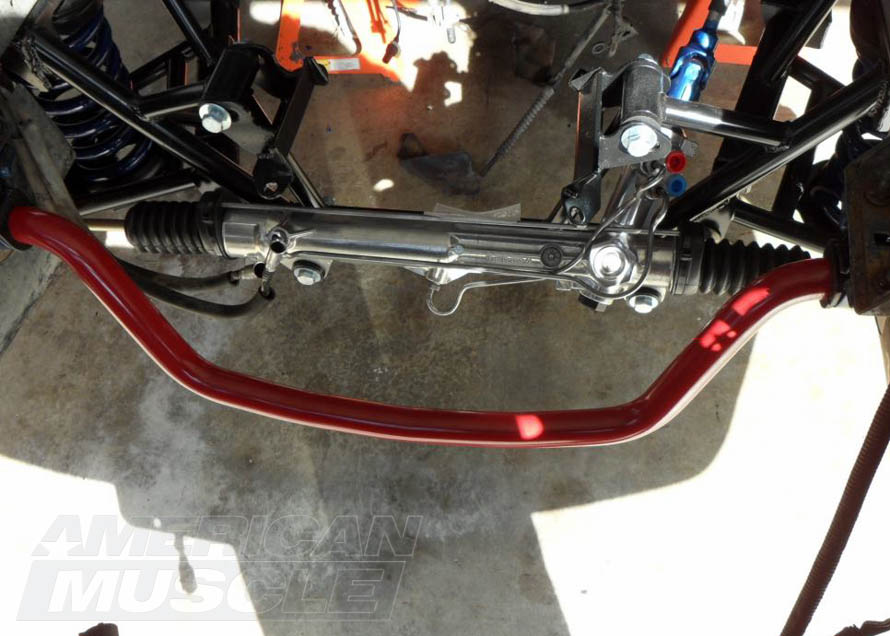
The late model Mustang's front end suspension tends to be a bit more than complicated than the rear, due to the steering rack and associated components. From 1997 until 2004, struts and springs were mounted separately with the spring closer to the engine. Showtime in 2005, the springs were mounted over the forepart struts upwardly in the top of the bicycle well. The wheel's spindle is mounted to the control arm, providing a point to mount the bike and tire. A sway bar is used to connect the two control arms together to control trunk roll.
Foxbody with a Front Sway Bar
Common Mustang Rear Suspension Components & the Divergence Between 4-Link and 3-Link Suspensions
Up until 2004, the late model Mustang's rear suspension used a four-link setup. Two upper and 2 lower control arms hold the rear beam in place, giving the suspension its four-link moniker. Springs support the rear of the car, higher up the axle, with separate shocks installed to control the dampening. The main issue with this suspension type is how the command arms are mounted. Instead of running parallel to each other, they're tilted slightly out. Combine this with Ford making their pony understeer like all hell, but when ran difficult will snap steer. In that location are reasons why control arms, K-members, and more are on a agglomeration of wish lists.
Depending upon whether your Mustang is a V6 or V8, it has a seven.five or an 8.8 inch rear end. The 7.v uses an open differential while the GT'southward 8.8 inch rear end uses Ford'southward Traction-Lok differential. The viii.8 inch rear end was also equipped with quad-shocks during these years which help dampen the axle and reduce wheel hop. A sway bar is installed on both versions of the rear finish to aid control body roll.
The rear suspension underwent a pregnant modify in the 2005 model year in terms of how the rear axle is positioned nether the car. The four-link interruption setup was nixed in favor of a three-link panhard bar setup, a compromise between a full contained rear suspension and a solid beam. A 3-link setup includes (2) lower control arms, simply simply (1) upper command arm.
An independent rear intermission would have added a substantial toll to the initial cost of the Mustang. In add-on, many Mustang enthusiasts prefer a solid rear axle anyway, as information technology's more than suitable for dragstrip duties The panhard bar setup preserves the solid axle while providing cornering ability improvements that adjust most owners better than previous Mustang generations.
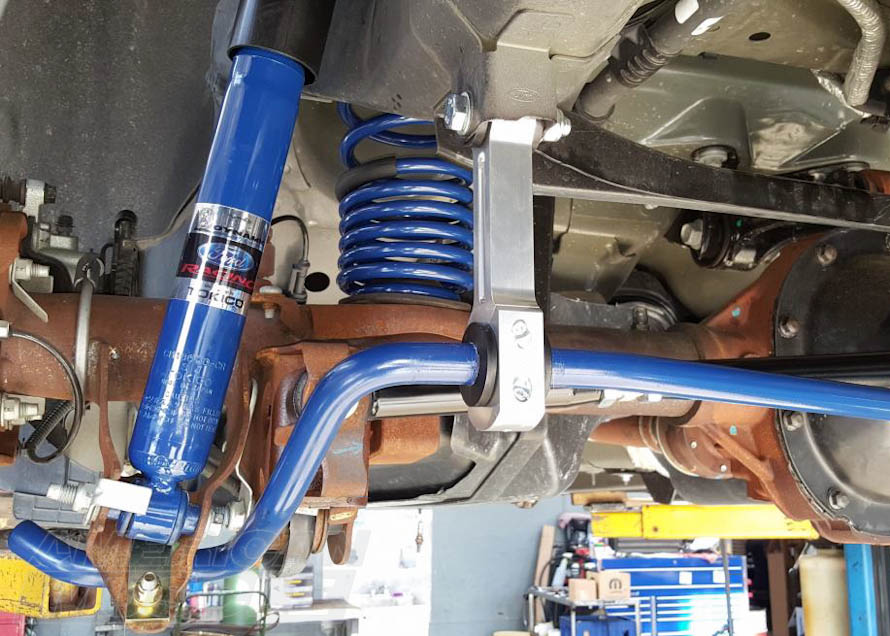
GT Rear with Aftermarket Shocks, Springs, and Sway Bar Installed
What is an Contained Rear Suspension & How Does it Work?
IRS setups allow both rear wheels to office and move independently of the other. This allows for greater command and handling. In IRS setups, at that place are ii half shafts, 1 going from the driver side rear wheel to the differential housing and one going from the rider side to the differential housing.
Should you be driving downwardly the road and hit a bump or a section of uneven pavement, your S550 Mustang volition feel more planted than previous generation Mustangs as each side of the car is affected and responds independently of the other side.
Although the system isn't worlds unlike (technically speaking) than the incredibly common LRA setup, it does offer a whole new level of operation/handling.
Differences & Benefits of IRS and LRA Mustang Setups
Live rear beam suspension systems are:
- More desirable for elevate racing
- Meliorate at straight-line dispatch
- Tend to exist able to handle college horsepower on stock components
- Cheaper to service and replace
Independent rear suspension setups are:
- More desirable for track racing/handling
- Less "squirley" and unpredictable
- Provide a smoother ride
- Can provide greater grip than LRA suspension systems
What Parts are Dissimilar on IRS Mustangs?
While the axle setup is i of the nigh obvious differences with IRS Mustangs, there are a handful of other parts that don't transition over from LRA equipped Mustangs. While some of them serve the same purpose, the enhanced grip and articulation of IRS systems requires a few additional parts to control the car.
- Vertical Links – these basically replace the lower command arms on LRA setups and work to keep the wheels planted, especially under load.
- IRS Bushings – unique to IRS setups, IRS bushings work to defeat deflection under load and wheel hop, reducing the corporeality of give/flex of the axles
- Rear Toe Links – serving a similar purpose and office every bit upper control arms, rear toe links allow the wheels on IRS S550 Mustangs to stay planted and adjust to lowered ride heights. These are crucial for maintaining a consequent and well-planted contact patch for the tires.
- Craddle-Bushing Lock Outs – These help go on the IRS cradle planted and on the footing, cutting down on deflection and cycle hop.
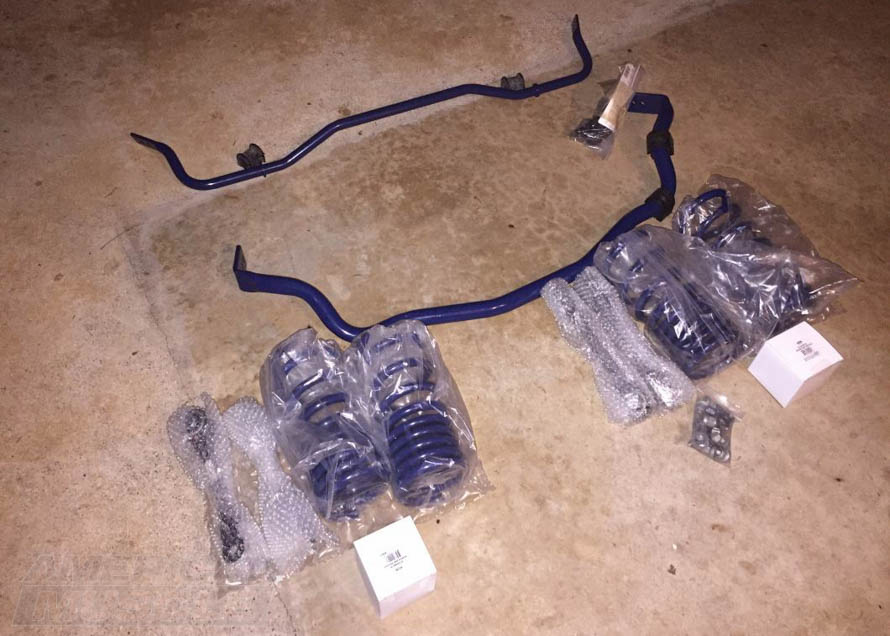
IRS Handling Pack Components
Tin can an LRA Mustang be Modified to Perform Similar an IRS Equipped Mustang?
Live rear beam Mustangs can amend drastically with extensive aftermarket modification, but they will never quite perform like an IRS equipped S550, particularly with the same amount of money put into it. The biggest issue with live axles is when you're going over anything other than a flat surface, the tires will exist tilted, decreasing traction. The Some S197 owners turn to mods like Watts-Link Suspension setups to help with the articulation and responsiveness of the setup, which ultimately tries to replicate the treatment profile of an IRS setup. If you're looking at calculation a Watts-Link or panhard to an older Mustang like a Foxbody or an SN95, y'all might run into clearance issues with the gas tank and/or exhaust arrangement. The aftermarket does offer specially designed units, merely be sure to bank check the manufacturer specs before committing to the expense.
Make no fault, with the right modifications you tin can profoundly improve an LRA'south handling abilities, but it will never be an optimal replacement or successor to IRS setups, especially in terms of overall smoothness while driving and runway racing.
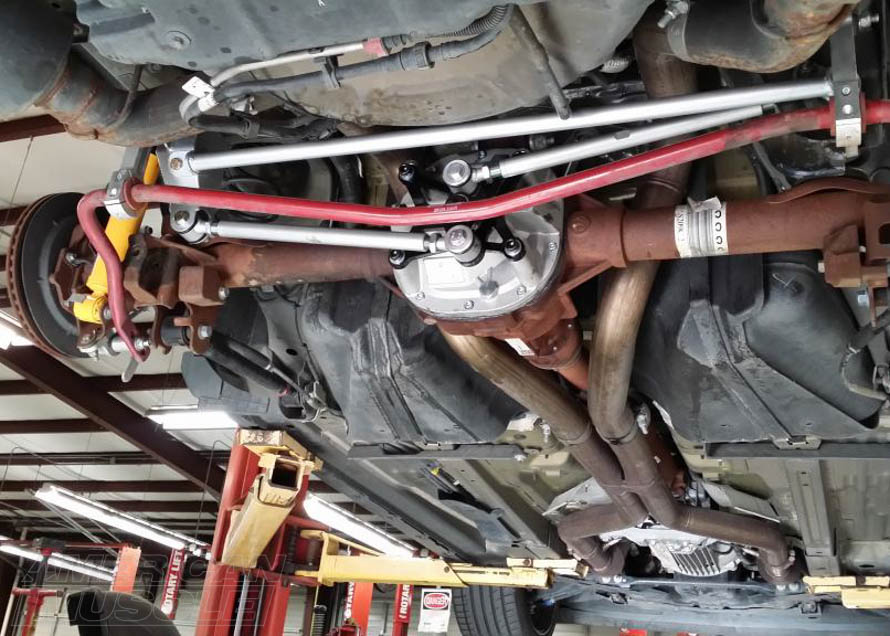
S197 LRA Watts Link Setup
Are S550 Mustang's Good For Drag Racing? Will The IRS System Break?
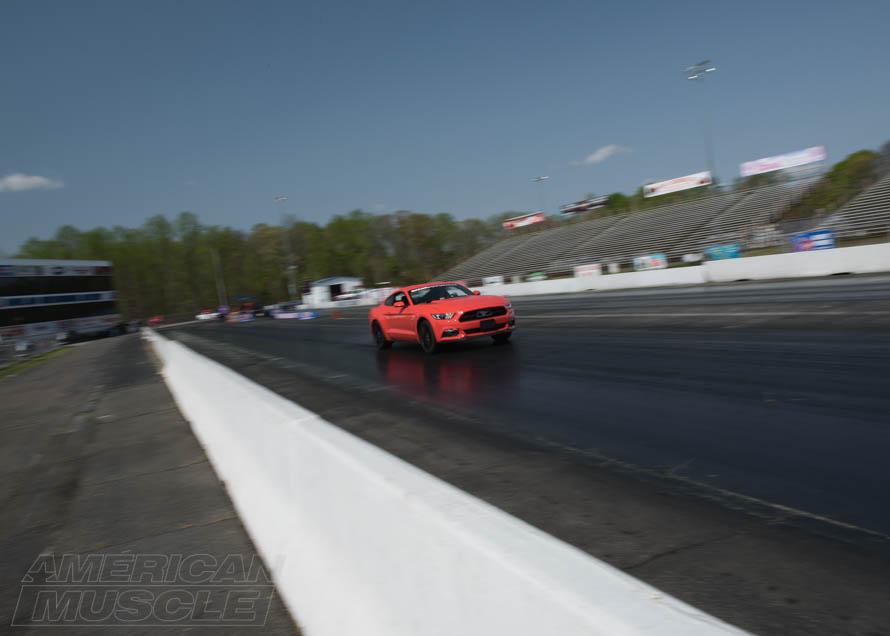
In that location seems to exist this misconception in the Mustang and racing community that IRS equipped 2015+ Mustangs can't quite hang with its predecessors in the quarter mile. An IRS powered S550 Mustang can be as competent as the Mustangs of yesteryear and can easily dip into single digit time slips.
Just like LRA Mustangs, and IRS S550 will need a little loving to perform at the summit of its course, which mainly comes from replacing the half shafts. The half shafts are the biggest weak point in the whole system and can fail, specially when launched at the rails on a sticky tire. Luckily for enthusiasts, aftermarket half shafts are readily available and easy enough to supercede.
One-half shafts are rated by the corporeality of horsepower they tin can safely withstand, allowing you to pick a gear up ideal for your build. If you are shooting for an S550 that puts down 600 HP and runs 10s, you don't demand the biggest, baddest half shafts bachelor. You tin purchase ones rated for 800 HP rather than the 1k shafts.
Is The 2015+ Ford Mustang the First Mustang to Use an IRS Setup?
The 2015 Mustang is non the get-go Mustang to use an contained rear intermission setup, reverse to what some may believe. The 2003 and 2004 Cobra Mustangs, aka Terminators, were the first to employ an IRS setup. Even so, due to some minor backlash in the community and issues with the IRS system, Ford never made information technology mainstream—at least non until 2015.
The '03 – '04 Cobra IRS arrangement is quite a chip different from the much more than modern/advanced S550 Mustang. Poor one-half shaft blueprint resulted in quite a few hardcore elevate racers replacing the IRS organisation with an LRA setup. While a step in what many would consider a stride in the correct direction, the 2003-2004 Cobra IRS system needed some major tweaking and revisions. One could argue those cars are the reason nosotros take IRS in the mainstream Mustang today.
Common Mustang Intermission Problems
There are a few common problems that bear on all stock Mustang owners and their treatment. Wheel hop. This is when your rear beam bounces upwards and downwards as it struggles to become traction, and is a mutual issue on all Mustangs, especially the S550 models. Mustangs can as well suffer from trunk roll off the line and going around turns due to lack of stiffening and back up throughout the frame. Any gen Mustang can feel somewhat floaty and high up due to the stock bound ratios, which are great for daily driving and arresting bumps and potholes, but awful for handling and curbside appeal.
Non-IRS equipped Mustangs (basically everything prior to 2015) can have bug in turns due to the solid rear axle (SRA) design that gets 'twitchy' when it hits a crash-land or uneven pavement. S550 Mustangs specifically tin can have problem getting off the line and launching due to weak IRS bushings having trouble keep the rear axles planted.
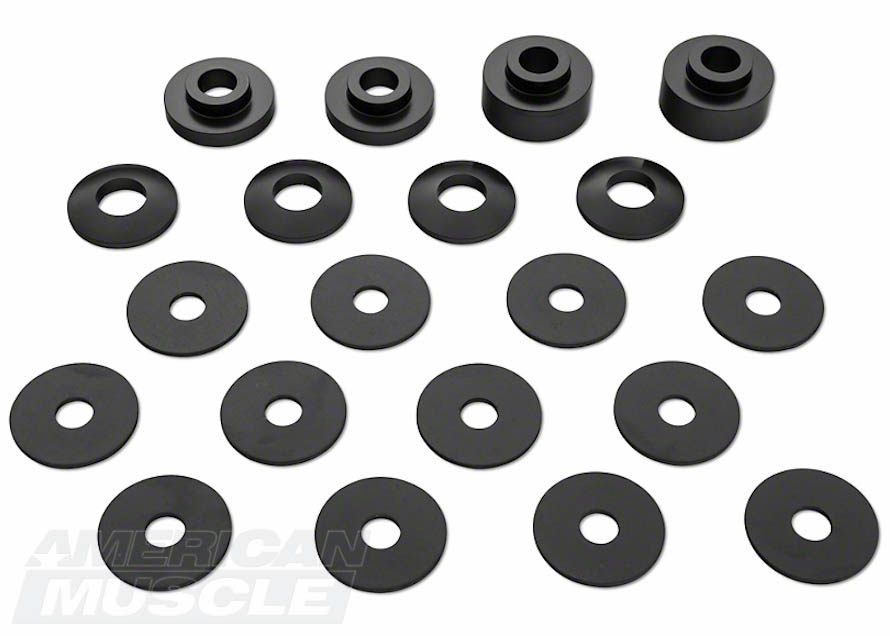
What Practise Mustang Intermission Bushings Practise?
From the factory, Ford uses rubber bushings throughout the Mustang's suspension. While condom bushings aren't the best option from a performance standpoint, they do assistance keep the toll downwardly and provide a smoother ride by controlling what's called NVH (Dissonance, Vibration, and Harshness). Keep in mind many Mustang owners never modify their car, so Ford'due south use of rubber bushings makes sense in that regard. Since prophylactic bushings suffer on the performance side, they're a contributor to bicycle hop.
If eliminating wheel hop is a priority, then replacement bushings should be a priority. While there are a few different types of materials available, the most unremarkably used is polyurethane. Polyurethane bushings will provide a much firmer feel than mill safety pieces and, when properly maintained, will outlast the stock components. While not the stiffest bushings, they're an ample upgrade from the factory safety. They give slightly more NVH than rubber bushings, and they practice need to be greased every few months, notwithstanding. These are fantastic for a daily driver.
Spherical Bushings: a meliorate type of bushing than poly, they are fantastic for drag launches and perform quite well in all applications. Their main drawback is just the amount of increased NVH, primarily the racket. For a daily commuter they are not optimal. The noise tends to get quite irritating. That being said, many apply them without complaints.
Aluminum: similar to poly bushings, they're great all-rounders. They're stiffer and have a little more than NVH than poly bushings. While information technology takes a little chip of time, they are susceptible to corroding as well. If yous're a road racer though, they can withstand much higher temperatures than rival bushings, fantastic for when the rear terminate generates a lot of heat.
S550 IRS bushings are crucial for owners aiming to drag race their pony every bit they take a lot of slack/slop and play out of the suspension. The stock bushings permit rear subframe motility that can ruin a quarter mile time. Aftermarket IRS bushings help the S550's rear feel more solid and planted, particularly when taking off from the line.
Mustang Air Lift Suspension Kits
An upgrade made popular past S197 Mustangs and has since spread out to other gens is replacing the main bits of the suspension with an air lift intermission kit. Air suspension kits remove the shocks, struts, and springs, replacing them with a pneumatically controlled airbag and air spring. These kits allow for extreme lowering (up to 5 inches) and can raise the suspension upwards to 1 inch over stock. Air lift kits are typically used on bear witness cars, however they exercise maintain solid performance in the turns and off the line.
A bonus of air ride is y'all can suit for awkward driveways and parking lots. A static lowered Mustang may be an unrealistic upgrade depending on the roads you travel. When thinking about air ride vs. lowering springs, y'all should remember about places you visit on a regular basis such equally stores and your chore. Other things to consider are routine maintenance. Can you become a jack under the car to lift it when changing your oil, or will you as well need to get some ramps to raise the motorcar plenty to use the jack? Later on considering all the potential problems, you lot may want to lower a motorcar a piffling less you had originally intended, or that an air ride setup is more appropriate for your build.
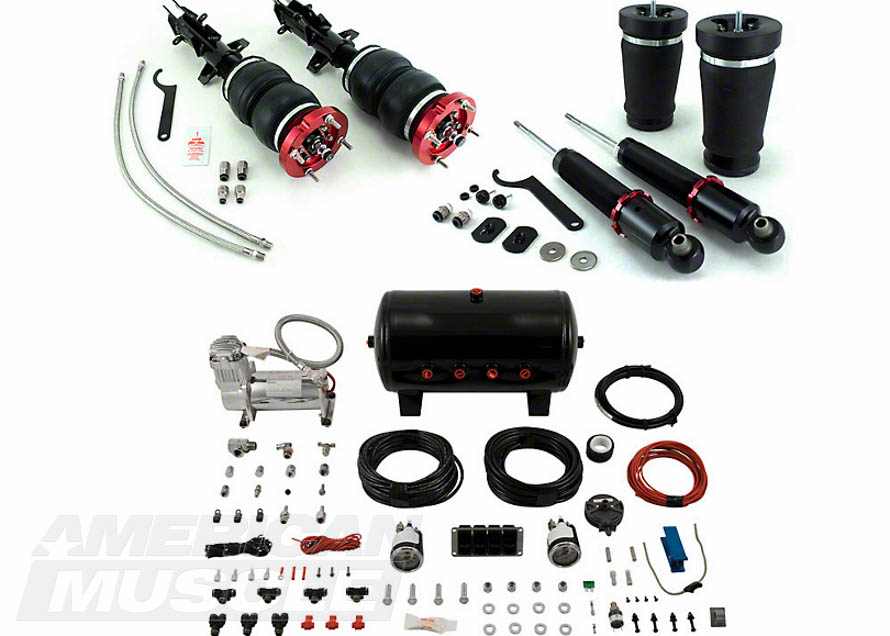
Complete Air Lift Suspension Kit
Mustang Coil Over Kits
Mustang curlicue over kits supplant the stock shocks, struts, and springs with one all-encompassing unit that provides a static drop height. Some of these kits allow you to preset/predetermine how depression you lot'd like to go, but the average driblet you tin can expect from a coil over kit is anywhere from 1 inch to two.5 inches.
Curlicue over kits are not necessarily ideal for daily drivers as they volition absorb bumps and potholes less efficiently, but they will provide arguably the best handling setup when compared to your other options.
MagneRide Honorable Mention: 2018+ S550 Mustang Interruption
Starting in 2018, Ford released their MagneRide suspension for Mustangs. The most notable difference betwixt MagneRide shocks and conventional shocks is the dampening fluid. Traditional shocks apply a blazon of oil. MagneRide, on the other manus, uses magnetorheological fluid, otherwise known as MR fluid. When the coils in the dampers provide an electric charge, MR fluid responds faster to changes in the route surface, stiffing your Mustang'south ride.
Which of These Parts Can I Install Myself?
Most suspensions parts can be self-installed inside a few hours. The primary reason for not self-installing sure parts are ones that crave an alignment after (CC plates, toe links, etc.), or parts that crave welding (torque box modifications, subframe connectors). Withal, for items like control artillery (front and rear), sway bars, springs, shocks, struts, panhard bars, etc., can all be installed provided y'all have the proper tools. Although brawl joint replacement/modifications crave specifically designed removal tools. The key is to make all suspension modifications with no load on the parts. Once installed, hand tighten the bolts and then lower the vehicle down before torqueing them to spec.
Fitment includes: 1979, 1980, 1981, 1982, 1983, 1984, 1985, 1986, 1987, 1988, 1989, 1990, 1991, 1992, 1993, 1994, 1995, 1996, 1997, 1998, 1999, 2000, 2001, 2002, 2003, 2004, 2005, 2006, 2007, 2008, 2009, 2010, 2011, 2012, 2013, 2014, 2015, 2016, 2017, 2018, 2019, GT, V6, Cobra, ShelbyGT500, Mach1, Bullitt, Dominate, Threescore, SVO, EcoBoost, ShelbyGT350
Related Manufactures
Source: https://www.americanmuscle.com/mustang-suspension-upgrade-guide.html
0 Response to "On 2003 Mustang Gt Do I Need to Beef Up Front Suspension for Turbo"
Post a Comment