The Family and Medical Leave Act Requires Employers to Provide Employees With
Introduction
Paid family and medical leave and sick leave can help workers run into their personal and family health care needs, while also fulfilling work responsibilities. Access to paid leave is a especially salient concern for women, who comprise almost one-half of the nation'south workforce and who are often the main caretaker for children and crumbling parents. Yet, many U.S. workers do not accept access to paid get out time.
The federal Family unit and Medical Get out Act (FMLA) requires eligible employers to provide certain workers unpaid family leave; yet, unlike nearly all other industrialized nations, the U.South. does not accept national standards on paid family or sick leave, despite strong public support. Paid leave has garnered increasing attention amid elected officials at the national and local level, peculiarly in calorie-free of the COVID-xix pandemic. Some temporary paid leave benefits programs were enacted as a event, though the bulk of those take since expired. Some employers also written report taking more than permanent action on their paid go out policies during this time. Some efforts at the federal level accept begun to gain momentum, including a provision of the 2020 Build Back Better Human activity that would create a national paid family unit and medical leave program. Additionally, the Healthy Families Act, which was introduced in 2019, which would crave most U.S. employers to offer workers paid sick get out, though efforts to bring it to a vote take since stalled. Many states and localities have passed laws to aggrandize access to paid leave to workers in their states. Employees not covered by these local laws must rely on voluntary employer policies, which can vary considerably in scope and compensation.
This fact sheet summarizes federal, land, and local policies on paid family and medical leave and paid sick exit and presents data from KFF Employer Health Benefits Surveys on the share of firms that offering workers these benefits.
Paid Sick Leave: Paid sick leave can exist used to recover from a short-term injury or disease such as a cold or for doctor's appointments. It is oft provided on an accrual ground up to a prepare number of hours or days per year, such as 1 60 minutes of leave earned for every thirty hours worked upwardly to seven days per year, and replaces 100% of the worker's regular wages. On average, private sector workers are offered seven days of paid sick leave per year. Paid sick leave benefits are paid by the employer.
Paid Family and Medical Go out: Paid family and medical get out typically provides a set number of weeks or months to be used for a worker'southward own serious, longer-term wellness condition, to care for a family unit member with a serious wellness condition, or to care for or bond with a new child, and for reasons related to a family's member'due south military service. On boilerplate, information technology provides six to twelve weeks of fully or partially paid leave per year, without the need for accrual. Paid family unit and medical go out may be insured and is often funded by contributions from the employer and/or the worker.
Federal, State, and Local Policies on Ill and Family and Medical Leave
Ill Exit
According to the Bureau of Labor Statistics (BLS), eight in ten workers (79%) have admission to paid sick go out through their employer in 2021; still, workers in certain occupations, role-fourth dimension workers, and lower-wage workers are less likely to have admission paid ill go out.
Proponents of a national paid sick leave mandate stress that workers should not be forced to choose between going to work sick and losing pay or their chore, pointing to numerous studies on the benefits of paid sick get out, including ameliorating financial burdens, preventing the spread of illnesses (including coronavirus), increased use of preventive health care services, reduced on-the-task injuries, and fewer inappropriate emergency room visits. Opponents of a national paid ill mandate generally debate that a mandate is not necessary because many employers already provide these benefits or that it should be a voluntary benefit. They cite concerns well-nigh the fiscal implications for employers who would be required to provide this benefit, specially for smaller businesses, and potential reductions in wages designed to offset those costs.
In that location is no federal requirement that employers offering paid leave to employees who are ill or demand time off to care for a sick a family unit fellow member. In 2020, the Families Commencement Coronavirus Response Act (FFCRA) temporarily required employers with fewer than 500 workers and all public employers to provide upwardly to 2 weeks of fully-paid sick exit to workers unable to work due to their own quarantine or symptoms of coronavirus. Those requirements expired at the end of 2020. In 2015, the Obama Administration issued an executive social club that requires federal contractors to offer at least 7 days of paid sick go out per twelvemonth to their employees, on an accrual basis, which took effect in 2017. At the time of enactment, this applied to approximately 300,000 people working on federal contracts. Furthermore, government employees take more often than not had access to paid sick leave through employee benefits packages. Introduced in Congress annually since 2004 (with some modifications), the Healthy Families Human action would crave employers nationwide with 15 or more employees to provide at least one hour of earned paid sick go out for every thirty hours workers, upward to 56 hours per yr (7 days based on a twoscore-hour work week). Employees would exist able to use sick leave for their ain disease, to intendance for a sick family unit fellow member, obtain medical care, or address needs resulting from domestic violence, sexual assault, or stalking, known as "safe fourth dimension." The Salubrious Families Human action has stalled in the House and Senate.
There has been more traction on paid sick leave policies at the state and local level. Since the start law was passed past voter initiative in 2006 in San Francisco, 14 states plus D.C., and 20 other localities take passed laws requiring covered employers to provide eligible employees paid fourth dimension off for their own illness or to care for sick children (Figure one).one Two additional states have full general paid leave laws that permit employees to use accrued go out for whatever reason, including affliction. Eight states and eleven localities permit use of accrued paid sick get out for workplace closure or closure of the worker'due south child's schoolhouse or childcare associated with a public health emergency. All land and all local paid ill leave laws except Pittsburgh, Oakland, and Berkeley permit apply of accrued leave for "prophylactic time." The telescopic and generosity of paid ill leave laws vary. Most state and local laws have exemptions based on the size and blazon of employer and/or let employers to impose certain worker eligibility requirements. Most laws likewise allow employers to impose a waiting period before new employees can use accrued leave, most often 90 days from the kickoff of employment. Laws mostly provide for accrual of 30-xl hours per year, though there is broad variation by policy, with lower accrual rates for smaller employers in many cases.
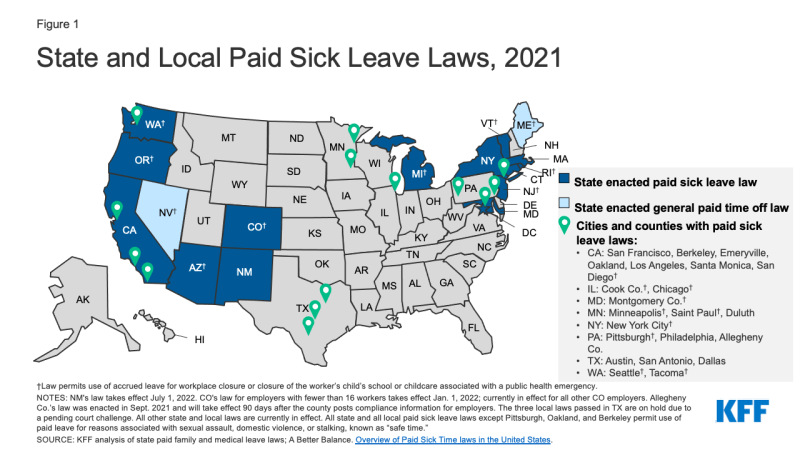
Figure 1: State and Local Paid Sick Leave Laws, 2021
Family and Medical Leave
FMLA and Unpaid Family and Medical Leave
The most recent nationwide policy reform occurred in 1993, when the federal government passed the Family and Medical Leave Act (FMLA), giving eligible employees up to 12 weeks of unpaid, job-protected get out per year for their own serious health condition, to treat a seriously ill family member, and for the arrival of a new child, besides as up to 26 weeks to address needs related to a family unit member'south military deployment. The law applies to public agencies and private employers with 50 or more employees. The FMLA has provided job security to millions of workers who demand to take fourth dimension off work for a qualifying reason; yet, just over one-half (56%) of the workforce is eligible for FMLA protections considering minor employers are exempt, and fifty-fifty in covered worksites, not all employees are eligible. As of 2018, 31 states and the Commune of Columbia take opted to expand job-protected exit benefits beyond FMLA's minimum standards by expanding eligibility, the duration of leave, the definition of family unit members, or qualified reasons for taking leave in the private and/or public sector.
Paid Family and Medical Leave
BLS data found that less than ane in iv (23%) workers have admission to paid family go out in 2021. Data on the share of workers with access to paid medical go out for a longer, serious illness are limited, merely BLS also estimates that xl% of workers have access to short-term disability insurance.
Proponents of a national paid family and medical plan leave urge that information technology would provide employees with greater fiscal security when they must take an extended leave for medical reasons or to care for an ailing family fellow member or new kid. Research indicates that admission to paid family and medical leave is associated with improved physical and mental health for new parents, decreased infant mortality, fiscal security for caregivers in the short- and long-term, and improved connections to the workforce, particularly for women, who are more likely than men to be caregivers for children and older adults. Opponents often cite concerns about the impact of new federal requirements on businesses, government overreach into the complimentary market, increased taxes for businesses (should that be the funding mechanism), equally well as the financial implications a new benefit would have on wages and employment.
At that place have been many attempts to enact a national paid get out policy, simply no permanent federal legislation has ever been passed. In 2020, the Families First Coronavirus Response Human activity (FFCRA) temporarily required U.South. employers with fewer than 500 workers and all public employers to provide upwards to 2 weeks of partially paid go out to workers who needed time off work to care for someone in quarantine or if their kid's school or daycare had airtight due to the pandemic; even so, requirement expired at the end of 2020. The Family unit and Medical Insurance Leave (FAMILY) Act, re-introduced in 117th Congress, if passed, would create a national insurance program to provide workers upwards to 12 weeks of their partial income for their own serious wellness condition or that of an immediate family member, and for the nascence or placement of a child. The programme would be funded by employee and employer payroll contributions. The Build Back Better Act, H.R. 5376, was adopted by the Business firm of Representatives on November 19, 2021, with the back up of President Biden, and is beingness considered through budget reconciliation. This broad bundle of wellness, social, and climatic change policies includes a provision for 4-weeks of partially-paid family and medical go out for about every U.Southward. worker, funded largely through full general revenues. As of December 2021, the Senate continues to debate the legislation and its passage remains uncertain.
There has been some progress on paid parental leave for federal workers. The Federal Employee Paid Leave Deed, which took issue in Oct 2020, grants federal employees 12 weeks of paid leave post-obit the birth or placement of a child. The policy, part of the National Defence force Authorization Human action for Fiscal Year 2020, applies to 2.1 million noncombatant workers employed by the federal government, though employees must have been in federal service for at least ane year to exist eligible and the legislation must be reauthorized for each fiscal year.
Nine states and D.C. have enacted paid family and medical get out laws in their jurisdictions (Figure 2), an increase from iv states in 2016.two , 3 , 4 In Nov 2020, Colorado became the first country to enact paid family and medical leave through a ballot measure. These programs provide paid time off for a worker's own serious illness, to care for a seriously ill family member, or to bond with a new child, with varying degrees of comprehensiveness. Three states also include time off for workers who need to address issues related to domestic violence, stalking, or sexual assault, known as "prophylactic fourth dimension." One state permits use of paid leave for reasons associated with a public health emergency, effective Jan. 2022. Paid leave durations for an employee'southward own serious medical condition range from 6 to 52 weeks per year and 4-12 weeks for family exit. Iv states5 plus D.C. provide a two–four-week extension for a worker'south ain pregnancy-related wellness problems. Wage replacement ranges from 50% to 100% of regular pay, upwards to certain caps. Some states provide benefits on a sliding scale, with a higher percentage of wage replacement for lower-income workers. Coverage for public sector and self-employed workers varies by country. All have minimum earnings or employment length requirements to qualify, and some have vii-twenty-four hour period unpaid waiting periods. Paid leave benefits are administered by the state or past employers with qualifying programs and are funded through employer and/or employee contributions.
Employer Health Benefits Survey Data
Paid Parental Leave
The 2019 KFF Employer Health Benefits Survey asked a nationally representative sample of non-federal public and private employers virtually the benefits they offer their employees. Overall, 25% of firms offer paid parental go out (either maternity, paternity, or both) to at least some employees for the nascency or placement of a kid. 30-five percent of workers are employed in firms that offer paid parental get out.
Paid parental leave offer rates vary by business firm characteristics such as size and wage levels. Firms with i,000 or more workers (35%) are more than likely to offering paid parental go out than smaller firms (Effigy 3). Among big firms (200 or more workers), firms with many college-wage workers6 (41%) are more likely to offer paid parental exit than firms with few higher-wage workers (23%) (Effigy four).
Paid Sick Leave
The 2017 Employer Health Benefits Survey found that about two in three firms (68%) provide paid sick leave to their total-fourth dimension workers (Figure five). Large firms (94%) were more probable than pocket-size firms (three-199 workers) (67%) to provide paid sick go out to their full-fourth dimension workers. While simply a pocket-sized fraction (one.7%) of firms in the U.S. are classified every bit large, they employ approximately 62% of the nation's workforce. Betwixt 2016 and 2017, the share of large firms offering paid ill leave to their full-fourth dimension workers increased from 84% to 94%.
Paid leave benefits are far less prevalent for part-time workers and are more than usually offered by large firms. Over one-half of big firms (56%) provided paid sick get out to their role-time workers, compared to most a quarter (26%) of pocket-sized firms. There is variation between dissimilar sizes of pocket-size and large firms in the provision of paid sick go out, for both full- and part-fourth dimension workers.
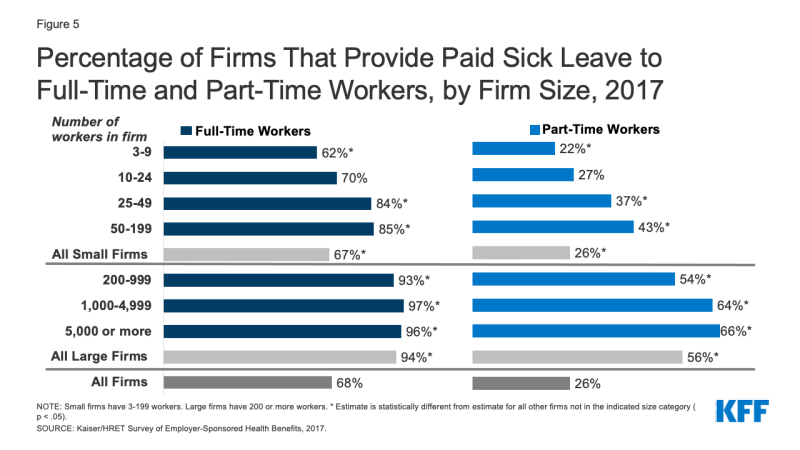
Figure v: Percentage of Firms That Provide Paid Sick Leave to Full-Time and Role-Time Workers, past Firm Size, 2017
Whether or not a house offers paid sick go out also depends on house characteristics. Amidst large firms, private for-profit firms (88%) are less likely to offer this benefit than private not-for-turn a profit (99%) and public employers (100%) (Figure 6). Additionally, big firms with at least some union workers (98%) are more than likely than firms with no union workers (92%) to provide paid sick leave to their full-fourth dimension staff.
Amid not-federal employees, 87% work in firms that offer paid sick leave to their full-time workers, and 50% work in firms that offer this benefit to part-time workers. The lower likelihood of paid sick get out for part-fourth dimension workers has a disproportionate impact on women, who are more probable than men to hold part-fourth dimension jobs. Women are also more likely than men to intendance for children when they are ill and accept to stay habitation from school.
Conclusion
Benefits such as sick leave and paid family and medical exit can help workers come across their personal and family health intendance needs with greater financial security. This issue has gained new urgency during the COVID-nineteen pandemic as workers needed fourth dimension off piece of work to recover from the virus and to intendance for children and other family members who had fallen sick. Some Democratic lawmakers accept introduced legislation that would create a national paid family unit and medical leave plan and a national paid ill exit program; however, it remains to exist seen whether Congress volition take these bills upwards. President Biden has spoken almost the need for supporting American families, and the Senate is currently debating budget reconciliation legislation that includes four weeks of paid family unit and medical get out for all U.Southward. workers, though the future of this provision, and the legislation as a whole, is uncertain. Brusk of that, the motility for paid get out will probable keep to be centered on state and local policies or those voluntarily adopted by employers or negotiated through marriage contracts. Given that most people will need time off during their working lives to intendance for a personal or family illness, or for a new kid, this issue will go on to exist a salient concern for working families across the land in the years to come.
Source: https://www.kff.org/womens-health-policy/fact-sheet/paid-leave-in-u-s/
0 Response to "The Family and Medical Leave Act Requires Employers to Provide Employees With"
Post a Comment