All of the Arts of the 19th Century Reflected a New Concern With
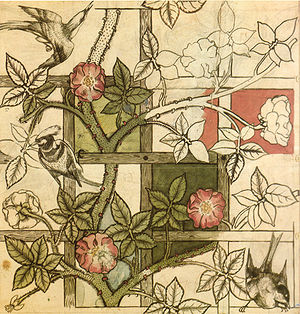
The Craft motility was an international trend in the decorative and fine arts that developed primeval and near fully in the British Isles[1] and after spread across the British Empire and to the residue of Europe and America.[ii]
Initiated in reaction against the perceived impoverishment of the decorative arts and the conditions in which they were produced,[3] the motility flourished in Europe and Due north America betwixt virtually 1880 and 1920. It is the root of the Modern Style, the British expression of what later came to be called the Fine art Nouveau movement, which it strongly influenced.[4] In Nihon it emerged in the 1920s as the Mingei movement. Information technology stood for traditional craftsmanship, and often used medieval, romantic, or folk styles of decoration. It advocated economical and social reform and was anti-industrial in its orientation.[three] [5] Information technology had a strong influence on the arts in Europe until information technology was displaced by Modernism in the 1930s,[1] and its influence connected among craft makers, designers, and town planners long later.[6]
The term was first used by T. J. Cobden-Sanderson at a meeting of the Arts and crafts Exhibition Society in 1887,[seven] although the principles and style on which information technology was based had been developing in England for at to the lowest degree 20 years. It was inspired past the ideas of builder Augustus Pugin, writer John Ruskin, and designer William Morris.[8] In Scotland it is associated with key figures such as Charles Rennie Mackintosh.[ix]
Origins and influences [edit]
Pattern reform [edit]
The Arts and Crafts motility emerged from the effort to reform design and decoration in mid-19th century Britain. Information technology was a reaction against a perceived decline in standards that the reformers associated with machinery and factory product. Their critique was sharpened by the items that they saw in the Great Exhibition of 1851, which they considered to be excessively ornate, artificial, and ignorant of the qualities of the materials used. Art historian Nikolaus Pevsner writes that the exhibits showed "ignorance of that basic need in creating patterns, the integrity of the surface", as well every bit displaying "vulgarity in item".[x] Design reform began with Exhibition organizers Henry Cole (1808–1882), Owen Jones (1809–1874), Matthew Digby Wyatt (1820–1877), and Richard Redgrave (1804–1888),[11] all of whom deprecated excessive ornament and impractical or desperately made things.[12] The organizers were "unanimous in their condemnation of the exhibits."[13] Owen Jones, for instance, complained that "the architect, the upholsterer, the paper-stainer, the weaver, the calico-printer, and the potter" produced "novelty without dazzler, or beauty without intelligence."[13] From these criticisms of manufactured goods emerged several publications which set out what the writers considered to exist the correct principles of design. Richard Redgrave's Supplementary Report on Design (1852) analysed the principles of design and ornament and pleaded for "more logic in the application of decoration."[12] Other works followed in a similar vein, such every bit Wyatt'southward Industrial Arts of the Nineteenth Century (1853), Gottfried Semper'south Wissenschaft, Industrie und Kunst ("Science, Manufacture and Art") (1852), Ralph Wornum's Analysis of Ornament (1856), Redgrave's Manual of Design (1876), and Jones's Grammar of Ornament (1856).[12] The Grammar of Ornamentation was especially influential, liberally distributed every bit a student prize and running into ix reprints by 1910.[12]
Jones declared that ornament "must be secondary to the thing decorated", that there must be "fitness in the ornament to the thing ornamented", and that wallpapers and carpets must not take any patterns "suggestive of anything only a level or plain".[14] A fabric or wallpaper in the Great Exhibition might be busy with a natural motif made to wait every bit existent equally possible, whereas these writers advocated apartment and simplified natural motifs. Redgrave insisted that "style" demanded sound structure before ornamentation, and a proper awareness of the quality of materials used. "Utility must have precedence over ornamentation."[15]

The Nature of Gothic past John Ruskin, printed by William Morris at the Kelmscott Press in 1892 in his Golden Type inspired by 15th century printer Nicolas Jenson. This chapter from The Stones of Venice (volume) was a sort of manifesto for the Arts and crafts motion.
All the same, the design reformers of the mid-19th century did not go as far equally the designers of the Arts and Crafts movement. They were more concerned with decoration than construction, they had an incomplete understanding of methods of manufacture,[15] and they did not criticise industrial methods as such. By dissimilarity, the Arts and Crafts movement was equally much a movement of social reform equally design reform, and its leading practitioners did not separate the two.
A. W. N. Pugin [edit]

Pugin's house "The Grange" in Ramsgate, 1843. Its simplified Gothic way, adapted to domestic building, helped shape the architecture of the Arts and crafts movement.
Some of the ideas of the movement were anticipated by A. W. Due north. Pugin (1812–1852), a leader in the Gothic revival in architecture. For example, he advocated truth to material, structure, and office, every bit did the Arts and Crafts artists.[sixteen] Pugin articulated the trend of social critics to compare the faults of modern society with the Middle Ages,[17] such equally the sprawling growth of cities and the treatment of the poor—a trend that became routine with Ruskin, Morris, and the Craft movement. His volume Contrasts (1836) drew examples of bad mod buildings and town planning in dissimilarity with good medieval examples, and his biographer Rosemary Hill notes that he "reached conclusions, almost in passing, about the importance of craftsmanship and tradition in compages that it would take the residuum of the century and the combined efforts of Ruskin and Morris to work out in particular." She describes the spare furnishings which he specified for a building in 1841, "blitz chairs, oak tables", as "the Arts and Crafts interior in embryo."[17]
John Ruskin [edit]
The Arts and Crafts philosophy was derived in large measure from John Ruskin'southward social criticism, deeply influenced by the piece of work of Thomas Carlyle.[18] Ruskin related the moral and social wellness of a nation to the qualities of its architecture and to the nature of its work. Ruskin considered the sort of mechanized production and partition of labour that had been created in the industrial revolution to exist "servile labour", and he thought that a healthy and moral society required independent workers who designed the things that they made. He believed factory-made works to be "dishonest," and that handwork and adroitness merged dignity with labour.[19] His followers favoured craft production over industrial manufacture and were concerned virtually the loss of traditional skills, but they were more troubled by the effects of the factory organisation than by machinery itself.[20] William Morris'southward idea of "handicraft" was essentially work without any partitioning of labour rather than work without any sort of machinery.[21]
William Morris [edit]

William Morris, a cloth designer who was a key influence on the Arts and Crafts movement
William Morris (1834–1896) was the towering figure in late 19th-century design and the main influence on the Arts and crafts movement. The aesthetic and social vision of the movement grew out of ideas that he developed in the 1850s with the Birmingham Prepare – a group of students at the University of Oxford including Edward Burne-Jones, who combined a dearest of Romantic literature with a delivery to social reform.[22] John William Mackail notes that "Carlyle'south Past and Present stood alongside of [Ruskin'south] Modern Painters as inspired and absolute truth."[23] The medievalism of Mallory'south Morte d'Arthur gear up the standard for their early on style.[24] In Burne-Jones' words, they intended to "wage Holy warfare against the age".[25]
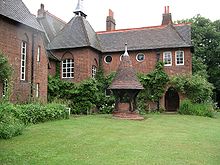
William Morris's Red House in Bexleyheath, designed by Philip Webb and completed in 1860; i of the nigh meaning buildings of the Arts and Crafts motion[26]
Morris began experimenting with various crafts and designing furniture and interiors.[27] He was personally involved in industry besides every bit design,[27] which was the hallmark of the Arts and Crafts movement. Ruskin had argued that the separation of the intellectual act of design from the manual deed of physical creation was both socially and aesthetically damaging. Morris farther developed this thought, insisting that no piece of work should be carried out in his workshops before he had personally mastered the appropriate techniques and materials, arguing that "without dignified, artistic homo occupation people became disconnected from life".[27]
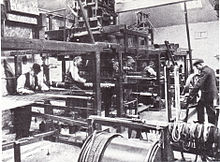
The weaving shed in Morris & Co's manufactory at Merton, which opened in the 1880s
In 1861, Morris began making article of furniture and decorative objects commercially, modelling his designs on medieval styles and using assuming forms and stiff colours. His patterns were based on flora and beast, and his products were inspired by the vernacular or domestic traditions of the British countryside. Some were deliberately left unfinished in order to display the beauty of the materials and the work of the craftsman, thus creating a rustic appearance. Morris strove to unite all the arts within the decoration of the dwelling house, emphasizing nature and simplicity of course.[28]
Social and design principles [edit]
Different their counterparts in the United states, most Arts and crafts practitioners in Britain had stiff, slightly incoherent, negative feelings nearly machinery. They idea of 'the craftsman' equally free, creative, and working with his hands, 'the machine' as soulless, repetitive, and inhuman. These contrasting images derive in function from John Ruskin's (1819–1900) The Stones of Venice, an architectural history of Venice that contains a powerful denunciation of modern industrialism to which Arts and crafts designers returned again and over again. Distrust for the machine lay backside the many piffling workshops that turned their backs on the industrial world around 1900, using preindustrial techniques to create what they called 'crafts.'
— Alan Crawford, "W. A. S. Benson, Mechanism, and the Arts and crafts Movement in Great britain"[29]
Critique of industry [edit]
William Morris shared Ruskin's critique of industrial social club and at in one case or another attacked the mod factory, the employ of machinery, the partitioning of labour, capitalism and the loss of traditional craft methods. But his mental attitude to machinery was inconsistent. He said at i signal that production by machinery was "altogether an evil",[10] only at others times, he was willing to commission piece of work from manufacturers who were able to meet his standards with the aid of machines.[xxx] Morris said that in a "truthful order", where neither luxuries nor cheap trash were made, mechanism could be improved and used to reduce the hours of labour.[31] Fiona MacCarthy says that "unlike later on zealots like Gandhi, William Morris had no applied objections to the employ of machinery per se so long as the machines produced the quality he needed."[32]
Morris insisted that the creative person should exist a craftsman-designer working by hand[10] and advocated a society of free craftspeople, such as he believed had existed during the Middle Ages. "Because craftsmen took pleasance in their work", he wrote, "the Heart Ages was a period of greatness in the fine art of the common people. ... The treasures in our museums at present are simply the mutual utensils used in households of that age, when hundreds of medieval churches – each one a masterpiece — were congenital by unsophisticated peasants."[33] Medieval art was the model for much of Arts and Crafts pattern, and medieval life, literature and edifice was idealised past the motility.
Morris's followers besides had differing views virtually machinery and the factory system. For example, C. R. Ashbee, a central effigy in the Arts and Crafts movement, said in 1888, that, "We practice not decline the car, we welcome it. But nosotros would desire to come across information technology mastered."[ten] [34] After unsuccessfully pitting his Guild and School of Handicraft guild confronting modern methods of manufacture, he best-selling that "Modernistic civilisation rests on machinery",[10] simply he continued to criticise the deleterious effects of what he called "mechanism", saying that "the product of certain mechanical commodities is equally bad for the national health as is the production of slave-grown cane or child-sweated wares."[35] William Arthur Smith Benson, on the other hand, had no qualms almost adapting the Arts and Crafts fashion to metalwork produced under industrial conditions. (See quotation box.)
Morris and his followers believed the division of labour on which modern industry depended was undesirable, but the extent to which every design should be carried out past the designer was a matter for argue and disagreement. Non all Arts and Crafts artists carried out every stage in the making of goods themselves, and information technology was only in the twentieth century that that became essential to the definition of adroitness. Although Morris was famous for getting hands-on feel himself of many crafts (including weaving, dying, printing, calligraphy and embroidery), he did non regard the separation of designer and executant in his factory as problematic. Walter Crane, a close political acquaintance of Morris's, took an unsympathetic view of the division of labour on both moral and artistic grounds, and strongly advocated that designing and making should come from the same hand. Lewis Foreman 24-hour interval, a friend and contemporary of Crane's, every bit unstinting as Crane in his adoration of Morris, disagreed strongly with Crane. He thought that the separation of design and execution was not simply inevitable in the modern world, simply also that only that sort of specialisation allowed the best in design and the best in making.[36] Few of the founders of the Arts and Crafts Exhibition Society insisted that the designer should also be the maker. Peter Floud, writing in the 1950s, said that "The founders of the Society ... never executed their own designs, but invariably turned them over to commercial firms."[37] The idea that the designer should be the maker and the maker the designer derived "non from Morris or early Arts and Crafts didactics, but rather from the 2d-generation elaboration doctrine worked out in the first decade of [the twentieth] century by men such as W. R. Lethaby".[37]
[edit]
Many of the Arts and Crafts movement designers were socialists, including Morris, T. J. Cobden Sanderson, Walter Crane, C.R. Ashbee, Philip Webb, Charles Faulkner, and A. H. Mackmurdo.[38] In the early on 1880s, Morris was spending more of his fourth dimension on promoting socialism than on designing and making.[39] Ashbee established a customs of craftsmen chosen the Gild of Handicraft in due east London, later moving to Chipping Campden.[7] Those adherents who were non socialists, such as Alfred Hoare Powell,[20] advocated a more humane and personal relationship between employer and employee. Lewis Foreman Day was another successful and influential Arts and crafts designer who was non a socialist, despite his long friendship with Crane.
Clan with other reform movements [edit]
In Britain, the movement was associated with apparel reform,[40] ruralism, the garden city movement[6] and the folk-song revival. All were linked, in some degree, by the platonic of "the Unproblematic Life".[41] In continental Europe the movement was associated with the preservation of national traditions in edifice, the applied arts, domestic pattern and costume.[42]
Development [edit]
Morris'south designs apace became popular, alluring interest when his visitor's work was exhibited at the 1862 International Exhibition in London. Much of Morris & Co's early work was for churches and Morris won of import interior design commissions at St James'southward Palace and the S Kensington Museum (now the Victoria and Albert Museum). Later his piece of work became popular with the center and upper classes, despite his wish to create a autonomous fine art, and past the terminate of the 19th century, Arts and Crafts design in houses and domestic interiors was the ascendant fashion in U.k., copied in products made by conventional industrial methods.
The spread of Arts and Crafts ideas during the late 19th and early 20th centuries resulted in the establishment of many associations and arts and crafts communities, although Morris had piffling to do with them because of his preoccupation with socialism at the time. A hundred and xxx Arts and Crafts organisations were formed in Britain, nearly between 1895 and 1905.[43]
In 1881, Eglantyne Louisa Jebb, Mary Fraser Tytler and others initiated the Abode Arts and Industries Association to encourage the working classes, especially those in rural areas, to accept up handicrafts under supervision, not for profit, but in gild to provide them with useful occupations and to meliorate their gustatory modality. Past 1889 it had 450 classes, 1,000 teachers and 5,000 students.[44]
In 1882, architect A.H.Mackmurdo formed the Century Guild, a partnership of designers including Selwyn Epitome, Herbert Horne, Cloudless Heaton and Benjamin Creswick.[45] [46]
In 1884, the Art Workers Order was initiated by 5 immature architects, William Lethaby, Edward Prior, Ernest Newton, Mervyn Macartney and Gerald C. Horsley, with the goal of bringing together fine and applied arts and raising the status of the latter. Information technology was directed originally past George Blackall Simonds. By 1890 the Guild had 150 members, representing the increasing number of practitioners of the Arts and Crafts way.[47] Information technology yet exists.
The London department store Liberty & Co., founded in 1875, was a prominent retailer of goods in the manner and of the "artistic wearing apparel" favoured by followers of the Craft move.
In 1887 the Arts and Crafts Exhibition Society, which gave its name to the movement, was formed with Walter Crane as president, belongings its starting time exhibition in the New Gallery, London, in November 1888.[48] It was the get-go prove of gimmicky decorative arts in London since the Grosvenor Gallery's Winter Exhibition of 1881.[49] Morris & Co. was well represented in the exhibition with furniture, fabrics, carpets and embroideries. Edward Burne-Jones observed, "here for the commencement time one can mensurate a bit the alter that has happened in the last twenty years".[50] The society all the same exists every bit the Guild of Designer Craftsmen.[51]
In 1888, C.R.Ashbee, a major late practitioner of the style in England, founded the Guild and School of Handicraft in the East End of London. The society was a craft co-operative modelled on the medieval guilds and intended to give working men satisfaction in their craftsmanship. Skilled craftsmen, working on the principles of Ruskin and Morris, were to produce hand-crafted appurtenances and manage a school for apprentices. The idea was greeted with enthusiasm by almost everyone except Morris, who was by now involved with promoting socialism and thought Ashbee's scheme trivial. From 1888 to 1902 the society prospered, employing almost 50 men. In 1902 Ashbee relocated the guild out of London to begin an experimental community in Chipping Campden in the Cotswolds. The social club'south piece of work is characterised by plain surfaces of hammered silver, flowing wirework and colored stones in simple settings. Ashbee designed jewellery and argent tableware. The gild flourished at Chipping Camden but did not prosper and was liquidated in 1908. Some craftsmen stayed, contributing to the tradition of mod adroitness in the area.[16] [52] [53]
C.F.A. Voysey (1857–1941) was an Arts and Crafts architect who also designed fabrics, tiles, ceramics, article of furniture and metalwork. His manner combined simplicity with composure. His wallpapers and textiles, featuring stylised bird and establish forms in bold outlines with flat colors, were used widely.[xvi]
Morris's thought influenced the distributism of Thou. Grand. Chesterton and Hilaire Belloc.[54]
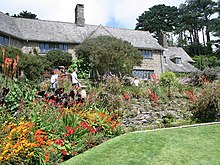
Coleton Fishacre was designed in 1925 as a holiday home in Kingswear, Devon, England, in the Arts and Crafts tradition.
Past the end of the nineteenth century, Arts and Crafts ideals had influenced architecture, painting, sculpture, graphics, illustration, volume making and photography, domestic pattern and the decorative arts, including furniture and woodwork, stained drinking glass,[55] leatherwork, lacemaking, embroidery, rug making and weaving, jewelry and metalwork, enameling and ceramics.[56] By 1910, there was a fashion for "Arts and Crafts" and all things paw-made. There was a proliferation of apprentice handicrafts of variable quality[57] and of incompetent imitators who caused the public to regard Craft every bit "something less, instead of more, competent and fit for purpose than an ordinary mass produced article."[58]
The Arts and Crafts Exhibition Lodge held 11 exhibitions betwixt 1888 and 1916. By the outbreak of war in 1914 information technology was in decline and faced a crunch. Its 1912 exhibition had been a financial failure.[59] While designers in continental Europe were making innovations in design and alliances with industry through initiatives such as the Deutsche Werkbund and new initiatives were beingness taken in U.k. by the Omega Workshops and the Blueprint in Industries Association, the Arts and crafts Exhibition Guild, now under the command of an old baby-sit, was withdrawing from commerce and collaboration with manufacturers into purist handwork and what Tania Harrod describes equally "decommoditisation"[59] Its rejection of a commercial role has been seen as a turning point in its fortunes.[59] Nikolaus Pevsner in his book Pioneers of Mod Design presents the Arts and Crafts movement as design radicals who influenced the modern movement, just failed to alter and were eventually superseded by it.[10]
Later influences [edit]
The British artist potter Bernard Leach brought to England many ideas he had developed in Nippon with the social critic Yanagi Soetsu most the moral and social value of simple crafts; both were enthusiastic readers of Ruskin. Leach was an active propagandist for these ideas, which struck a chord with practitioners of the crafts in the inter-state of war years, and he expounded them in A Potter'due south Book, published in 1940, which denounced industrial society in terms every bit vehement every bit those of Ruskin and Morris. Thus the Arts and crafts philosophy was perpetuated amidst British arts and crafts workers in the 1950s and 1960s, long later on the demise of the Arts and Crafts movement and at the high tide of Modernism. British Utility furniture of the 1940s too derived from Arts and crafts principles.[60] One of its main promoters, Gordon Russell, chairman of the Utility Piece of furniture Design Panel, was imbued with Arts and Crafts ideas. He manufactured furniture in the Cotswold Hills, a region of Arts and Crafts furniture-making since Ashbee, and he was a member of the Arts and Crafts Exhibition Society. William Morris'due south biographer, Fiona MacCarthy, detected the Arts and crafts philosophy even behind the Festival of Britain (1951), the work of the designer Terence Conran (b. 1931)[6] and the founding of the British Crafts Council in the 1970s.[61]
By region [edit]
The British Isles [edit]

Stained glass window, The Hill House, Helensburgh, Argyll and Bute
Scotland [edit]
The beginnings of the Arts and crafts movement in Scotland were in the stained drinking glass revival of the 1850s, pioneered by James Ballantine (1808–1877). His major works included the great w window of Dunfermline Abbey and the scheme for St. Giles Cathedral, Edinburgh. In Glasgow it was pioneered by Daniel Cottier (1838–1891), who had probably studied with Ballantine, and was straight influenced by William Morris, Ford Madox Brown and John Ruskin. His fundamental works included the Baptism of Christ in Paisley Abbey, (c. 1880). His followers included Stephen Adam and his son of the aforementioned name.[62] The Glasgow-built-in designer and theorist Christopher Dresser (1834–1904) was one of the first, and nearly important, independent designers, a pivotal figure in the Aesthetic Motion and a major contributor to the allied Anglo-Japanese movement.[63] The movement had an "extraordinary flowering" in Scotland where it was represented past the development of the 'Glasgow Way' which was based on the talent of the Glasgow School of Art. Celtic revival took hold here, and motifs such as the Glasgow rose became popularised. Charles Rennie Mackintosh (1868 – 1928) and the Glasgow Schoolhouse of Art were to influence others worldwide.[i] [56]

Wales [edit]
The state of affairs in Wales was different than elsewhere in the UK. Insofar as adroitness was concerned, Craft was a revivalist campaign. But in Wales, at least until World War I, a genuine craft tradition notwithstanding existed. Local materials, stone or clay, continued to be used every bit a matter of course.[64]
Scotland become known in the Arts and Crafts motion for its stained glass; Wales would become known for its pottery. By the mid 19th century, the heavy, table salt glazes used for generations by local craftsmen had gone out of way, non least as mass-produced ceramics undercut prices. But the Craft Movement brought new appreciation to their work. Horace West Elliot, an English gallerist, visited the Ewenny Pottery (which dated back to the 17th century) in 1885, to both find local pieces and encourage a mode compatible with the motility.[65] The pieces he brought back to London for the next xx years revivified involvement in Welsh pottery work.
A key promoter of the Arts and Crafts movement in Wales was Owen Morgan Edwards. Edwards was a reforming politico dedicated to renewing Welsh pride by exposing its people to their own language and history. For Edwards, "There is goose egg that Wales requires more an teaching in the arts and crafts."[66]—though Edwards was more inclined to resurrecting Welsh Nationalism than admiring glazes or rustic integrity.[67]
In architecture, Clough Williams-Ellis sought to renew interest in ancient edifice, reviving "rammed earth" or pisé[1] structure in Britain.
Ireland [edit]
The movement spread to Ireland, representing an important fourth dimension for the nation's cultural development, a visual counterpart to the literary revival of the aforementioned time[68] and was a publication of Irish nationalism. The Craft use of stained glass was popular in Ireland, with Harry Clarke the best-known artist and also with Evie Strop. The architecture of the style is represented by the Honan Chapel (1916) in Cork city in the grounds of University College Cork.[69] Other architects practicing in Ireland included Sir Edwin Lutyens (Heywood House in Co. Laois, Lambay Island and the Irish National State of war Memorial Gardens in Dublin) and Frederick 'Pa' Hicks (Malahide Castle estate buildings and round tower). Irish Celtic motifs were popular with the movement in silvercraft, carpet design, volume illustrations and hand-carved piece of furniture.
Continental Europe [edit]
In continental Europe, the revival and preservation of national styles was an important motive of Arts and Crafts designers; for example, in Germany, after unification in 1871 under the encouragement of the Bund für Heimatschutz (1897)[70] and the Vereinigte Werkstätten für Kunst im Handwerk founded in 1898 past Karl Schmidt; and in Hungary Károly Kós revived the vernacular style of Transylvanian building. In key Europe, where several various nationalities lived under powerful empires (Deutschland, Austria-Hungary and Russia), the discovery of the colloquial was associated with the exclamation of national pride and the striving for independence, and, whereas for Arts and crafts practitioners in Britain the ideal way was to be constitute in the medieval, in central Europe information technology was sought in remote peasant villages.[71]

Widely exhibited in Europe, the Arts and crafts style'south simplicity inspired designers similar Henry van de Velde and styles such as Fine art Nouveau, the Dutch De Stijl group, Vienna Secession, and eventually the Bauhaus way. Pevsner regarded the style as a prelude to Modernism, which used unproblematic forms without ornamentation.[ten]
The primeval Arts and crafts activity in continental Europe was in Belgium in about 1890, where the English style inspired artists and architects including Henry Van de Velde, Gabriel Van Dievoet, Gustave Serrurier-Bovy and a group known every bit La Libre Esthétique (Free Aesthetic).
Arts and Crafts products were admired in Austria and Germany in the early 20th century, and nether their inspiration design moved apace forrad while it stagnated in Britain.[72] The Wiener Werkstätte, founded in 1903 past Josef Hoffmann and Koloman Moser, was influenced by the Craft principles of the "unity of the arts" and the hand-made. The Deutscher Werkbund (German Association of Craftsmen) was formed in 1907 as an association of artists, architects, designers, and industrialists to improve the global competitiveness of German language businesses and became an important element in the development of modern compages and industrial pattern through its advancement of standardized production. However, its leading members, van de Velde and Hermann Muthesius, had conflicting opinions about standardization. Muthesius believed that it was essential were Federal republic of germany to become a leading nation in trade and culture. Van de Velde, representing a more traditional Craft attitude, believed that artists would forever "protest against the imposition of orders or standardization," and that "The artist ... will never, of his own accord, submit to a field of study which imposes on him a catechism or a blazon." [73]
In Finland, an idealistic artists' colony in Helsinki was designed by Herman Gesellius, Armas Lindgren and Eliel Saarinen,[1] who worked in the National Romantic way, akin to the British Gothic Revival.
In Hungary, under the influence of Ruskin and Morris, a group of artists and architects, including Károly Kós, Aladár Körösfői-Kriesch and Ede Toroczkai Wigand, discovered the folk fine art and colloquial architecture of Transylvania. Many of Kós's buildings, including those in the Budapest zoo and the Wekerle manor in the same city, testify this influence.[74]
In Russia, Viktor Hartmann, Viktor Vasnetsov, Yelena Polenova and other artists associated with Abramtsevo Colony sought to revive the quality of medieval Russian decorative arts quite independently from the movement in Great britain.
In Republic of iceland, Sölvi Helgason'due south work shows Craft influence.
North America [edit]


Warren Wilson Embankment House (The Venice Beach House), Venice, California

Adventure House, Pasadena, California

Arts and Crafts Tudor Home in the Buena Park Celebrated Commune, Uptown, Chicago

Instance of Arts and Crafts mode influence on Federation architecture Detect the faceted bay window and the stone base.

Arts and Crafts domicile in the Birckhead Place neighborhood of Toledo, Ohio
In the U.s.a., the Arts and Crafts style initiated a multifariousness of attempts to reinterpret European Arts and Crafts ideals for Americans. These included the "Craftsman"-mode architecture, furniture, and other decorative arts such as designs promoted by Gustav Stickley in his magazine, The Craftsman and designs produced on the Roycroft campus as publicized in Elbert Hubbard'due south The Fra. Both men used their magazines as a vehicle to promote the goods produced with the Craftsman workshop in Eastwood, NY and Elbert Hubbard's Roycroft campus in East Aurora, NY. A host of imitators of Stickley's furniture (the designs of which are frequently mislabelled the "Mission Style") included three companies established by his brothers.
The terms American Craftsman or Craftsman style are often used to denote the fashion of compages, interior blueprint, and decorative arts that prevailed between the dominant eras of Art Nouveau and Art Deco in the US, or approximately the period from 1910 to 1925. The movement was particularly notable for the professional opportunities it opened upwards for women as artisans, designers and entrepreneurs who founded and ran, or were employed by, such successful enterprises as the Kalo Shops, Pewabic Pottery, Rookwood Pottery, and Tiffany Studios. In Canada, the term Arts and crafts predominates, but Craftsman is as well recognized.[75]
While the Europeans tried to recreate the virtuous crafts beingness replaced by industrialisation, Americans tried to constitute a new type of virtue to supplant heroic arts and crafts production: well-busy centre-course homes. They claimed that the uncomplicated but refined aesthetics of Arts and Crafts decorative arts would ennoble the new experience of industrial consumerism, making individuals more rational and society more harmonious. The American Arts and crafts movement was the aesthetic counterpart of its contemporary political philosophy, progressivism. Characteristically, when the Craft Club began in October 1897 in Chicago, it was at Hull House, 1 of the first American settlement houses for social reform.[76]
Arts and crafts ideals disseminated in America through periodical and paper writing were supplemented by societies that sponsored lectures.[76] The offset was organized in Boston in the belatedly 1890s, when a group of influential architects, designers, and educators determined to bring to America the pattern reforms begun in U.k. by William Morris; they met to organize an exhibition of gimmicky craft objects. The first meeting was held on January 4, 1897, at the Museum of Fine Arts (MFA) in Boston to organize an exhibition of gimmicky crafts. When craftsmen, consumers, and manufacturers realised the aesthetic and technical potential of the applied arts, the process of pattern reform in Boston started. Present at this meeting were General Charles Loring, Chairman of the Trustees of the MFA; William Sturgis Bigelow and Denman Ross, collectors, writers and MFA trustees; Ross Turner, painter; Sylvester Baxter, fine art critic for the Boston Transcript; Howard Bakery, A.W. Longfellow Jr.; and Ralph Clipson Sturgis, architect.
The get-go American Arts and Crafts Exhibition began on April v, 1897, at Copley Hall, Boston featuring more than than 1000 objects fabricated by 160 craftsmen, half of whom were women.[77] Some of the advocates of the exhibit were Langford Warren, founder of Harvard's School of Architecture; Mrs. Richard Morris Hunt; Arthur Astor Carey and Edwin Mead, social reformers; and Will H. Bradley, graphic designer. The success of this exhibition resulted in the incorporation of The Guild of Arts and Crafts (SAC), on June 28, 1897, with a mandate to "develop and encourage higher standards in the handicrafts." The 21 founders claimed to be interested in more than than sales, and emphasized encouragement of artists to produce work with the best quality of workmanship and design. This mandate was soon expanded into a credo, possibly written past the SAC's outset president, Charles Eliot Norton, which read:
This Order was incorporated for the purpose of promoting creative work in all branches of handicraft. It hopes to bring Designers and Workmen into mutually helpful relations, and to encourage workmen to execute designs of their own. It endeavors to stimulate in workmen an appreciation of the dignity and value of good design; to annul the pop impatience of Constabulary and Form, and the desire for over-ornamentation and specious originality. It will insist upon the necessity of sobriety and restraint, or ordered arrangement, of due regard for the relation between the form of an object and its apply, and of harmony and fitness in the ornament put upon information technology.[78]
Built in 1913-fourteen by the Boston architect J. Williams Beal in the Ossipee Mountains of New Hampshire, Tom and Olive Plant's mountaintop estate, Castle in the Clouds also known equally Lucknow, is an splendid example of the American Craftsman mode in New England.[79]
As well influential were the Roycroft community initiated by Elbert Hubbard in Buffalo and Eastward Aurora, New York, Joseph Marbella, utopian communities like Byrdcliffe Colony in Woodstock, New York, and Rose Valley, Pennsylvania, developments such as Mountain Lakes, New Bailiwick of jersey, featuring clusters of bungalow and chateau homes built by Herbert J. Hapgood, and the gimmicky studio craft mode. Studio pottery—exemplified by the Grueby Faience Visitor, Newcomb Pottery in New Orleans, Marblehead Pottery, Teco pottery, Overbeck and Rookwood pottery and Mary Hunt Perry Stratton's Pewabic Pottery in Detroit, the Van Briggle Pottery company in Colorado Springs, Colorado, as well equally the art tiles made past Ernest A. Batchelder in Pasadena, California, and idiosyncratic furniture of Charles Rohlfs all demonstrate the influence of Arts and Crafts.
Architecture and Art [edit]
The "Prairie School" of Frank Lloyd Wright, George Washington Maher and other architects in Chicago, the Country Mean solar day School movement, the bungalow and ultimate bungalow style of houses popularized by Greene and Greene, Julia Morgan, and Bernard Maybeck are some examples of the American Craft and American Craftsman style of architecture. Restored and landmark-protected examples are yet nowadays in America, especially in California in Berkeley and Pasadena, and the sections of other towns originally adult during the era and not experiencing mail service-war urban renewal. Mission Revival, Prairie Schoolhouse, and the 'California bungalow' styles of residential building remain popular in the U.s.a. today.
As theoreticians, educators, and prolific artists in mediums from printmaking to pottery and pastel, two of the most influential figures were Arthur Wesley Dow (1857-1922) on the East Declension and Pedro Joseph de Lemos (1882-1954) in California. Dow, who taught at Columbia University and founded the Ipswich Summer School of Fine art, published in 1899 his landmark Composition, which distilled into a distinctly American approach the essence of Japanese composition, combining into a decorative harmonious constructing iii elements: simplicity of line, "notan" (the balance of light and dark areas), and symmetry of color.[lxxx] His purpose was to create objects that were finely crafted and beautifully rendered. His student de Lemos, who became caput of the San Francisco Art Found, Director of the Stanford Academy Museum and Art Gallery, and Editor-in-Chief of the School Arts Mag, expanded and substantially revised Dow's ideas in over 150 monographs and manufactures for art schools in the United states and Britain.[81] Among his many unorthodox teachings was his belief that manufactured products could express "the sublime beauty" and that keen insight was to exist found in the abstract "design forms" of pre-Columbian civilizations.
Museums [edit]
The Museum of the American Arts and crafts Movement in St. Petersburg, Florida, opened its doors in 2019.[82] [83]
Asia [edit]
In Nihon, Yanagi Sōetsu, creator of the Mingei movement which promoted folk art from the 1920s onwards, was influenced by the writings of Morris and Ruskin.[33] Like the Craft movement in Europe, Mingei sought to preserve traditional crafts in the face of modernising industry.
Architecture [edit]
The motility ... represents in some sense a revolt against the hard mechanical conventional life and its insensibility to beauty (quite another thing to ornament). It is a protest against that and then-called industrial progress which produces shoddy wares, the cheapness of which is paid for by the lives of their producers and the degradation of their users. Information technology is a protest against the turning of men into machines, against artificial distinctions in art, and confronting making the immediate market value, or possibility of profit, the master test of creative merit. It also advances the claim of all and each to the common possession of beauty in things common and familiar, and would awaken the sense of this beauty, deadened and depressed as it now likewise oft is, either on the one mitt by luxurious superfluities, or on the other by the absenteeism of the commonest necessities and the gnawing anxiety for the ways of livelihood; non to speak of the everyday uglinesses to which we take accustomed our optics, confused by the alluvion of imitation taste, or darkened by the hurried life of modern towns in which huge aggregations of humanity exist, equally removed from both fine art and nature and their kindly and refining influences.
-- Walter Crane, "Of The Revival of Blueprint and Handicraft", in Arts and crafts Essays, by Members of the Arts and Crafts Exhibition Society, 1893
Many of the leaders of the Arts and Crafts movement were trained as architects (east.g. William Morris, A. H. Mackmurdo, C. R. Ashbee, W. R. Lethaby) and information technology was on building that the movement had its most visible and lasting influence.
Red House, in Bexleyheath, London, designed for Morris in 1859 by architect Philip Webb, exemplifies the early Arts and Crafts manner, with its well-proportioned solid forms, wide porches, steep roof, pointed window arches, brick fireplaces and wooden fittings. Webb rejected classical and other revivals of historical styles based on grand buildings, and based his pattern on British vernacular architecture, expressing the texture of ordinary materials, such every bit stone and tiles, with an asymmetrical and picturesque edifice composition.[16]
The London suburb of Bedford Park, congenital mainly in the 1880s and 1890s, has about 360 Arts and Crafts style houses and was once famous for its Artful residents. Several Almshouses were built in the Arts and Crafts style, for case, Whiteley Hamlet, Surrey, built betwixt 1914 and 1917, with over 280 buildings, and the Dyers Almshouses, Sussex, built between 1939 and 1971. Letchworth Garden City, the first garden urban center, was inspired by Arts and Crafts ideals.[6] The first houses were designed by Barry Parker and Raymond Unwin in the vernacular style popularized by the motility and the town became associated with loftier-mindedness and simple living. The sandal-making workshop set by Edward Carpenter moved from Yorkshire to Letchworth Garden City and George Orwell'southward jibe about "every fruit-juice drinker, nudist, sandal-wearer, sex-bedlamite, Quaker, 'Nature Cure' quack, pacifist, and feminist in England" going to a socialist conference in Letchworth has go famous.[84]
Architectural examples [edit]
- Red House – Bexleyheath, Kent – 1859
- David Parr Business firm - Cambridge, England - 1886-1926
- Wightwick Estate – Wolverhampton, England – 1887–93
- Inglewood – Leicester, England – 1892
- Standen – Due east Grinstead, England – 1894
- Swedenborgian Church – San Francisco, California – 1895
- Mary Ward House - Bloomsbury, London - 1896-98
- Blackwell – Lake District, England – 1898
- Derwent House – Chislehurst, Kent – 1899
- Stoneywell – Ulverscroft, Leicestershire – 1899
- The Arts & Crafts Church (Long Street Methodist Church and School) – Manchester, England – 1900
- Spade House – Sandgate, Kent – 1900
- Caledonian Estate – Islington, London – 1900–1907
- Horniman Museum – Forest Hill, London – 1901
- All Saints' Church, Brockhampton - 1901-02
- Shaw's Corner – Ayot St Lawrence, Hertfordshire – 1902
- Pierre P. Ferry House – Seattle, Washington – 1903–1906
- Winterbourne Firm – Birmingham, England – 1904
- The Black Friar – Blackfriars, London – 1905
- Marston House – San Diego, California – 1905
- Edgar Forest Middle – Manchester, England – 1905
- Debenham Firm – Holland Park, London – 1905-07
- Robert R. Blacker House – Pasadena, California – 1907
- Stotfold, Bickley, Kent - 1907
- Run a risk House – Pasadena, California – 1908
- Oregon Public Library – Oregon, Illinois – 1909
- Thorsen House – Berkeley, California – 1909
- Rodmarton Manor – Rodmarton, near Cirencester, Gloucestershire – 1909–29
- Whare Ra – Havelock North, New Zealand – 1912
- Sutton Garden Suburb – Benhilton, Sutton, London – 1912–14
- Castle in the Clouds - Ossipee Mountains at Lake Winnipesaukee, New Hampshire - 1913-4
- Honan Chapel – University College Cork, Republic of ireland – c.1916
- St Francis Xavier'south Cathedral – Geraldton Western Commonwealth of australia 1916–1938
- Bedales School Memorial Library – near Petersfield, Hampshire – 1919–21
Garden design [edit]
Gertrude Jekyll applied Arts and Crafts principles to garden design. She worked with the English language architect, Sir Edwin Lutyens, for whose projects she created numerous landscapes, and who designed her dwelling house Munstead Wood, near Godalming in Surrey.[85] Jekyll created the gardens for Bishopsbarns,[86] the home of York architect Walter Brierley, an exponent of the Arts and Crafts motion and known as the "Lutyens of the Due north".[87] The garden for Brierley'south final project, Goddards in York, was the work of George Dillistone, a gardener who worked with Lutyens and Jekyll at Castle Drogo.[88] At Goddards the garden incorporated a number of features that reflected the arts and crafts fashion of the house, such as the use of hedges and herbaceous borders to divide the garden into a series of outdoor rooms.[89] Another notable Arts and Crafts garden is Hidcote Manor Garden designed by Lawrence Johnston which is also laid out in a series of outdoor rooms and where, like Goddards, the landscaping becomes less formal farther away from the house.[90] Other examples of Arts and crafts gardens include Hestercombe Gardens, Lytes Cary Manor and the gardens of some of the architectural examples of arts and crafts buildings (listed higher up).
Art teaching [edit]
Morris'south ideas were adopted past the New Educational activity Movement in the belatedly 1880s, which incorporated handicraft teaching in schools at Abbotsholme (1889) and Bedales (1892), and his influence has been noted in the social experiments of Dartington Hall during the mid-20th century.[61]
Arts and crafts practitioners in Uk were critical of the authorities system of art education based on blueprint in the abstract with fiddling teaching of applied arts and crafts. This lack of arts and crafts training also caused business in industrial and official circles, and in 1884 a Royal Commission (accepting the advice of William Morris) recommended that fine art education should pay more than attention to the suitability of pattern to the textile in which information technology was to be executed.[91] The first school to make this change was the Birmingham School of Craft, which "led the way in introducing executed design to the teaching of art and blueprint nationally (working in the cloth for which the design was intended rather than designing on paper). In his external examiner'southward report of 1889, Walter Crane praised Birmingham Schoolhouse of Art in that it 'considered design in human relationship to materials and usage.'"[92] Nether the direction of Edward Taylor, its headmaster from 1877 to 1903, and with the help of Henry Payne and Joseph Southall, the Birmingham School became a leading Arts-and-Crafts centre.[93]
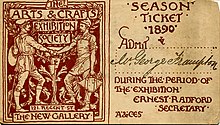
George Frampton. Season ticket to The Arts and Arts and crafts Exhibition Society 1890.
Other local authorization schools too began to innovate more than practical teaching of crafts, and by the 1890s Craft ethics were being disseminated by members of the Art Workers Guild into art schools throughout the state. Members of the Order held influential positions: Walter Crane was managing director of the Manchester School of Art and subsequently the Royal Higher of Fine art; F.M. Simpson, Robert Anning Bell and C.J.Allen were respectively professor of architecture, instructor in painting and blueprint, and teacher in sculpture at Liverpool School of Art; Robert Catterson-Smith, the headmaster of the Birmingham Fine art School from 1902 to 1920, was also an AWG member; W. R. Lethaby and George Frampton were inspectors and advisors to the London County Council'due south (LCC) teaching board and in 1896, largely as a result of their work, the LCC set up up the Primal School of Arts and Crafts and fabricated them joint principals.[94] Until the germination of the Bauhaus in Germany, the Cardinal Schoolhouse was regarded every bit the most progressive fine art school in Europe.[95] Soon after its foundation, the Camberwell School of Arts and Crafts was set upwards on Craft lines by the local borough council.
As head of the Imperial College of Fine art in 1898, Crane tried to reform it along more practical lines, but resigned subsequently a twelvemonth, defeated by the bureaucracy of the Board of Education, who and so appointed Augustus Spencer to implement his programme. Spencer brought in Lethaby to head its school of design and several members of the Fine art Workers' Guild every bit teachers.[94] Ten years subsequently reform, a commission of inquiry reviewed the RCA and found that information technology was even so non adequately training students for industry.[96] In the fence that followed the publication of the committee's report, C.R.Ashbee published a highly critical essay, Should We Finish Teaching Art, in which he chosen for the system of fine art instruction to exist completely dismantled and for the crafts to be learned in country-subsidised workshops instead.[97] Lewis Foreman Twenty-four hours, an important figure in the Arts and crafts motion, took a different view in his dissenting report to the committee of enquiry, arguing for greater emphasis on principles of design confronting the growing orthodoxy of teaching design by direct working in materials. Nevertheless, the Arts and Crafts ethos thoroughly pervaded British art schools and persisted, in the view of the historian of fine art educational activity, Stuart MacDonald, until subsequently the Second World War.[94]
Leading practitioners [edit]
- Charles Robert Ashbee
- William Swinden Barber
- Barnsley brothers
- Detmar Accident
- Herbert Tudor Buckland
- Rowland Wilfred William Carter
- T. J. Cobden-Sanderson
- Walter Crane
- Nelson Dawson
- Lewis Foreman Day
- Christopher Dresser
- Dirk van Erp
- Thomas Phillips Figgis
- Eric Gill
- Ernest Gimson
- Greene & Greene
- Elbert Hubbard
- Norman Jewson
- Ralph Johonnot
- Florence Koehler
- Frederick Leach
- William Lethaby
- Edwin Lutyens
- Charles Rennie Mackintosh
- A.H.Mackmurdo
- Samuel Maclure
- George Washington Maher
- Bernard Maybeck
- Henry Chapman Mercer
- Julia Morgan
- William De Morgan
- William Morris
- Karl Parsons
- Alfred Hoare Powell
- Edward Schroeder Prior
- Hugh C. Robertson
- William Robinson
- Baillie Scott
- Norman Shaw
- Ellen Gates Starr
- Gustav Stickley
- Phoebe Anna Traquair
- C.F.A. Voysey
- Philip Webb
- Margaret Ely Webb
- Christopher Whall
- Edgar Forest
- Charles Rohlfs
Decorative arts gallery [edit]
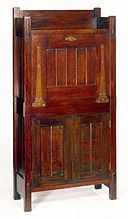
See as well [edit]
- Modernistic Mode (British Art Nouveau style)
- Philip Clissett
- The English House
- Charles Prendergast
- William Morris wallpaper designs
- William Morris textile designs
References [edit]
- ^ a b c d Campbell, Gordon (2006). The Grove Encyclopedia of Decorative Arts, Book 1. Oxford University Press. ISBN978-0-nineteen-518948-3.
- ^ Wendy Kaplan and Alan Crawford, The Arts & Crafts motility in Europe & America: Design for the Modern World, Los Angeles County Museum of Art
- ^ a b Brenda M. King, Silk and Empire
- ^ "Arts and crafts movement | British and international movement". Encyclopedia Britannica.
- ^ Moses N. Ikiugu and Elizabeth A. Ciaravino, Psychosocial Conceptual Practise models in Occupational Therapy; "Arts and Crafts Way Guide". British Galleries. Victoria and Albert Museum. Retrieved 17 July 2007.
- ^ a b c d Fiona MacCarthy, Anarchy and Beauty: William Morris and his Legacy 1860-1960, London: National Portrait Gallery, 2014 ISBN 978 185514 484 2
- ^ a b Alan Crawford, C. R. Ashbee: Architect, Designer & Romantic Socialist, Yale University Printing, 2005. ISBN 0300109393
- ^ Triggs, Oscar Lovell (1902). Chapters in the History of the Craft Movement. Bohemia Guild of the Industrial Art League.
- ^ Sumpner, Dave; Morrison, Julia (28 Feb 2020). My Revision Notes: Pearson Edexcel A Level Design and Engineering science (Product Pattern). Hodder Education. ISBN978-1-5104-7422-ii.
- ^ a b c d e f g Nikolaus Pevsner, Pioneers of Modern Design, Yale University Press, 2005, ISBN 0-300-10571-one
- ^ "V&A, "Wallpaper Blueprint Reform"".
- ^ a b c d Naylor 1971, p. 21.
- ^ a b Naylor 1971, p. xx.
- ^ Quoted in Nikolaus Pevsner, Pioneers of Modern Design
- ^ a b Naylor 1971, p. 22.
- ^ a b c d "Victoria and Albert Museum". Vam.ac.u.k.. Retrieved 28 August 2010.
- ^ a b Rosemary Hill, God's Builder: Pugin and the Edifice of Romantic United kingdom of great britain and northern ireland, London: Allen Lane, 2007
- ^ Blakesley, Rosalind P. (2009). The Arts and crafts Motion. Phaidon Press. ISBN 978-0714849676.
- ^ "John Ruskin - Creative person Philosopher Writer - Arts & Crafts Leader". www.arts-crafts.com. Archived from the original on eighteen December 2019. Retrieved 16 March 2019.
- ^ a b Jacqueline Sarsby" Alfred Powell: Idealism and Realism in the Cotswolds", Journal of Design History, Vol. x, No. 4, pp. 375–397
- ^ David Pye, The Nature and Art of Workmanship, Cambridge University Press, 1968
- ^ Naylor 1971, pp. 96–97.
- ^ Mackail, J. W. (2011). The Life of William Morris. New York: Dover Publications. p. 38. ISBN 978-0486287935.
- ^ Wildman 1998, p. 49.
- ^ Naylor 1971, p. 97.
- ^ "National Trust, "Iconic Arts and Crafts dwelling of William Morris"".
- ^ a b c MacCarthy 2009.
- ^ "The Arts and Crafts Movement in America". The Metropolitan Museum of Art. 2019. Retrieved 16 March 2019.
- ^ Alan Crawford, "W. A. S. Benson, Machinery, and the Craft Movement in Britain", The Journal of Decorative and Propaganda Arts, Vol. 24, Design, Culture, Identity: The Wolfsonian Drove (2002), pp. 94–117
- ^ Graeme Shankland, "William Morris - Designer", in Asa Briggs (ed.) William Morris: Selected Writings and Designs, Harmondsworth: Penguin, 1980 ISBN 0-14-020521-vii
- ^ William Morris, "Useful Work versus Useless Toil", in Asa Briggs (ed.) William Morris: Selected Writings and Designs, Harmondsworth: Penguin, 1980 ISBN 0-fourteen-020521-7
- ^ MacCarthy 1994, p. 351.
- ^ a b Elisabeth Frolet, Nick Pearce, Soetsu Yanagi and Sori Yanagi, Mingei: The Living Tradition in Japanese Arts, Nihon Folk Crafts Museum/Glasgow Museums, Japan: Kodashani International, 1991
- ^ Ashbee, C. R., A Few Chapters on Workshop Structure and Citizenship, London, 1894.
- ^ "C. R. Ashbee, Should We Terminate Teaching Art?, New York and London: Garland, 1978, p.12 (Facsimile of the 1911 edition)
- ^ "Designer and Executant: An Argument Between Walter Crane and Lewis Foreman Day".
- ^ a b Peter Floud, "The crafts and then and now", The Studio, 1953, p.127
- ^ Naylor 1971, p. 109.
- ^ MacCarthy 1994, p. 640-663.
- ^ "V&A, "Victorian Dress at the V&A"".
- ^ Fiona McCarthy. The Simple Life, Lund Humphries, 1981
- ^ "Arts and Crafts movement". Retrieved 5 July 2019.
- ^ MacCarthy 1994, p. 602.
- ^ Naylor 1971, p. 120.
- ^ MacCarthy 1994, p. 591.
- ^ Naylor 1971, p. 115.
- ^ MacCarthy 1994, p. 593.
- ^ Parry, Linda, William Morris and the Craft Movement: A Sourcebook, New York, Portland House, 1989 ISBN 0-517-69260-0
- ^ "Crane, Walter, "Of the Arts and crafts Movement", in Ideals In Art: Papers Theoretical Practical Disquisitional, George Bell & Sons, 1905". Chestofbooks.com. Retrieved 28 August 2010.
- ^ MacCarthy 1994, p. 596.
- ^ "Society of Designer Craftsmen". Society of Designer Craftsmen. Retrieved 28 Baronial 2010.
- ^ "Utopia Britannica". Utopia Britannica. Retrieved 28 August 2010.
- ^ "Courtroom Barn Museum". Courtbarn.org.uk. Archived from the original on 29 January 2010. Retrieved 28 August 2010.
- ^ Letter, Joseph Nuttgens, London Review of Books, thirteen May 2010 p four
- ^ Cormack, Peter (2015). Arts and Crafts Stained Drinking glass (Outset ed.). New Haven and London: Yale Academy Printing. ISBN978-0-300-20970-ix.
- ^ a b Nicola Gordon Bowe and Elizabeth Cumming, The Arts and crafts Movements in Dublin and Edinburgh
- ^ "Arts and Crafts", Periodical of the Royal Society of Arts, Vol. 56, No. 2918, 23 Oct 1908, pp. 1023-1024
- ^ Noel Rooke, "The Craftsman and Education for Industry", in 4 Papers Read by Members of the Arts & Crafts Exhibition Society, London: Arts and Crafts Exhibition Society, 1935
- ^ a b c Tania Harrod, The Crafts in Great britain in the 20th Century, Yale Academy Press, 1999. ISBN 0-300-07780-vii
- ^ Designing Britain Archived May 15, 2010, at the Wayback Machine
- ^ a b MacCarthy 1994, p. 603.
- ^ M. MacDonald, Scottish Art (London: Thames and Hudson, 2000), ISBN 0500203334, p. 151.
- ^ H. Lyons, Christopher Dresser: The People Designer - 1834–1904 (Antique Collectors' Club, 2005), ISBN 1851494553.
- ^ Hilling, John B. (15 August 2018). The Architecture of Wales: From the First to the Xx-First Century. Academy of Wales Press. p. 221. ISBN978-1-78683-285-6. 'Arts and Crafts' to Early Modernism, 1900 to 1939
- ^ Aslet, Clive (four Oct 2010). Villages of Great britain: The Five Hundred Villages that Made the Countryside. A&C Blackness. p. 477. ISBN978-0-7475-8872-6.
- ^ Davies, Hazel; Council, Welsh Arts (one January 1988). O. M. Edwards. University of Wales Printing on behalf of Welsh Arts Council. p. 28. ISBN9780708309971. Sec. 3
- ^ Rothkirch, Alyce von; Williams, Daniel (2004). Beyond the Departure: Welsh Literature in Comparative Contexts : Essays for K. Wynn Thomas at Sixty. University of Wales Press. p. 10. ISBN978-0-7083-1886-seven.
- ^ Nicola Gordon Bowe, The Irish Craft Motion (1886-1925), Irish Arts Review Yearbook, 1990-91, pp. 172-185
- ^ Teehan & Heckett 2005, p. 163.
- ^ Ákos Moravánszky, Competing visions: aesthetic invention and social imagination in Fundamental European Architecture 1867-1918, Massachusetts Establish of Engineering science, 1998
- ^ Andrej Szczerski, "Central Europe", in Karen Livingstone and Linda Parry (eds.), International Arts and Crafts, London: V&A Publications, 2005
- ^ Naylor 1971, p. 183.
- ^ Naylor 1971, p. 189.
- ^ Széleky András, Kós Károly, Budapest, 1979
- ^ "Metropolitan Museum of Art: Monica Obniski, "The Arts and crafts Motility in America"". Metmuseum.org. 20 Feb 1972. Retrieved 28 August 2010.
- ^ a b Obniski.
- ^ "The Arts & Crafts Motility - Concepts & Styles". The Art Story . Retrieved 25 Dec 2020.
- ^ Brandt, Beverly Kay. The Craftsman and the Critic: Defining Usefulness and Dazzler in the Arts and Crafts-era Boston. Academy of Massachusetts Press, 2009. p. 113.
- ^ Cahn, Lauren. (March 13, 2019) "The Virtually Famous House in Every State. Image #29: Castle in the Clouds" MSN.com website. Retrieved April 29, 2019.
- ^ Green, Nancy E. and Jessie Poesch (1999). Arthur Wesley Dow and American arts & crafts. New York, NY: Harry N. Abrams, Inc. pp. 55–126. ISBN0810942178.
- ^ Edwards, Robert Due west. (2015). Pedro de Lemos, Lasting Impressions: Works on Paper. Worcester, Mass.: Davis Publications Inc. pp. 4–111. ISBN9781615284054.
- ^ "Construction Begins on $40 One thousand thousand Museum of the American Arts & Crafts in Florida". ARTFIX Daily. 18 February 2015. Retrieved three March 2015.
- ^ Nichols, Steve (18 February 2015). "New, bigger, art museum coming to St. Pete". Fob xiii Pinellas Bureau Reporter. Archived from the original on 21 February 2015. Retrieved iii March 2015.
- ^ George Orwell, The Road to Wigan Pier
- ^ Tankard, Judith B. and Martin A. Wood. Gertrude Jekyll at Munstead Wood. Bramley Books, 1998.
- ^ Historic England. "Bishopsbarns (1256793)". National Heritage List for England . Retrieved 23 June 2016.
- ^ "The Art of Design" (PDF). www.nationaltrust.org.uk . Retrieved 26 June 2016.
- ^ Historic England. "Castle Drogo park and garden (1000452)". National Heritage List for England . Retrieved 26 June 2016.
- ^ "The Gardens at Goddards". world wide web.nationaltrust.org.uk . Retrieved 26 June 2016.
- ^ "The Garden at Hidcote". world wide web.nationaltrust.org.united kingdom . Retrieved 6 July 2016.
- ^ Charles Harvey and Jon Printing, "William Morris and the Majestic Committee on Technical Pedagogy", Journal of the William Morris Society 11.i, August 1994, pp. 31-34 Archived 2015-01-05 at the Wayback Car
- ^ ""Birmingham Institute of Fine art and Pattern" fineart.ac.uk".
- ^ Everitt, Sian. "Keeper of Archives". Birmingham Institute of Art and Design . Retrieved 17 September 2011.
- ^ a b c Stuart Macdonald, The History and Philosophy of Art Didactics, London: Academy of London Press, 1970. ISBN 0 340 09420 half-dozen
- ^ Naylor 1971, p. 179.
- ^ Written report of the Departmental Committee on the Royal College of Fine art, HMSO, 1911
- ^ C.R.Ashbee, Should We Stop Teaching Art?, 1911
Bibliography and farther reading [edit]
- Ayers, Dianne (2002). American Craft Textiles. New York: Harry North. Abrams. ISBN0-8109-0434-9.
- Blakesley, Rosalind P. The craft movement (Phaidon, 2006).
- Boris, Eileen (1986). Art and Labor . Philadelphia: Temple University Press. ISBN0-87722-384-X.
- Carruthers, Annette. The Arts and crafts Move in Scotland: A History (2013) online review
- Cathers, David M. (1981). Furniture of the American Arts and crafts Movement. The New American Library, Inc. ISBN0-453-00397-four.
- Cathers, David One thousand. (2014). And so Various Are The Forms Information technology Assumes: American Arts & Crafts Piece of furniture from the Two Red Roses Foundation. Marquand Books. ISBN978-0-692-21348-3.
- Cathers, David Chiliad. (20 February 2017). These Humbler Metals: Arts and Crafts Metalwork from the Two Cherry-red Roses Foundation Collection. Marquand Books. ISBN978-0-615-98869-six.
- Cormack, Peter. Arts & crafts stained glass (Yale UP, 2015).
- Cumming, Elizabeth; Kaplan, Wendy (1991). Arts & Crafts Movement. London: Thames & Hudson. ISBN0-500-20248-6.
- Cumming, Elizabeth (2006). Hand, Center and Soul: The Arts and crafts Movement in Scotland. Birlinn. ISBN978-1-84158-419-5.
- Danahay, Martin. "Arts and crafts as a Transatlantic Movement: CR Ashbee in the United States, 1896–1915." Periodical of Victorian Civilization xx.1 (2015): 65–86.
- Greensted, Mary. The arts and crafts movement in Uk (Shire, 2010).
- Johnson, Bruce (2012). Arts & Crafts Shopmarks. Fletcher, NC: Knock On Wood Publications. ISBN978-1-4507-9024-six.
- Kaplan, Wendy (1987). The Fine art that Is Life: The Arts & Crafts Movement in America 1875-1920. New York: Footling, Brown and Company.
- Kreisman, Lawrence, and Glenn Mason. The Arts & Craft Movement in the Pacific Northwest (Timber Press, 2007).
- Krugh, Michele. "Joy in labour: The politicization of arts and crafts from the arts and crafts move to Etsy." Canadian Review of American Studies 44.2 (2014): 281–301. online
- Luckman, Susan. "Precarious labour then and now: The British craft movement and cultural work revisited." Theorizing Cultural Work (Routledge, 2014) pp. 33–43 online.
- MacCarthy, Fiona (2009). "Morris, William (1834–1896), designer, writer, and visionary socialist". Oxford Lexicon of National Biography (online ed.). Oxford University Press. doi:ten.1093/ref:odnb/19322. (Subscription or UK public library membership required.)
- MacCarthy, Fiona (1994). William Morris. Faber and Faber. ISBN0-571-17495-seven.
- Mascia-Lees, Frances E. "American Beauty: The Middle Course Arts and crafts Revival in the United States." in Disquisitional Craft (Routledge, 2020) pp. 57–77.
- Meister, Maureen. Arts and crafts Architecture: History and Heritage in New England (Upwards of New England, 2014).
- Naylor, Gillian (1971). The Craft Motility: a study of its sources, ideals and influence on pattern theory . London: Studio Vista. ISBN028979580X.
- Parry, Linda (2005). Textiles of the Craft Movement. London: Thames and Hudson. ISBN0-500-28536-5.
- Penick, Monica, Christopher Long, and Harry Ransom Center, eds. The rise of everyday design: The craft movement in United kingdom of great britain and northern ireland and America (Yale UP, 2019).
- Richardson, Margaret. Architects of the arts and crafts motility (1983)
- Tankard, Judith B. Gardens of the Arts and crafts Movement (Timber Press, 2018)
- Teehan, Virginia; Heckett, Elizabeth (2005). The Honan Chapel: A Gilt Vision. Cork: Cork University Press. ISBN978-1-8591-8346-5.
- Thomas, Zoë. "Betwixt Art and Commerce: Women, Business Ownership, and the Arts and Crafts Move." By & Present 247.1 (2020): 151–196. online
- Triggs, Oscar Lovell. The arts & crafts motion (Parkstone International, 2014).
- Wildman, Stephen (1998). Edward Burne-Jones, Victorian artist-dreamer. New York: Metropolitan Museum of Art. ISBN9780870998584 . Retrieved 26 Dec 2013.
External links [edit]
- Fiona MacCarthy, "The one-time romantics", The Guardian, Saturday 5 March 2005 01.25 GMT
- Furniture makers of America and Canada during the Arts & Crafts Movement
- The commencement public museum exclusively defended to the American Arts & Crafts movement
- Catalog lists with images of the major American Arts & Crafts furniture makers Archived 2017-06-21 at the Wayback Machine
Source: https://en.wikipedia.org/wiki/Arts_and_Crafts_movement
0 Response to "All of the Arts of the 19th Century Reflected a New Concern With"
Post a Comment